
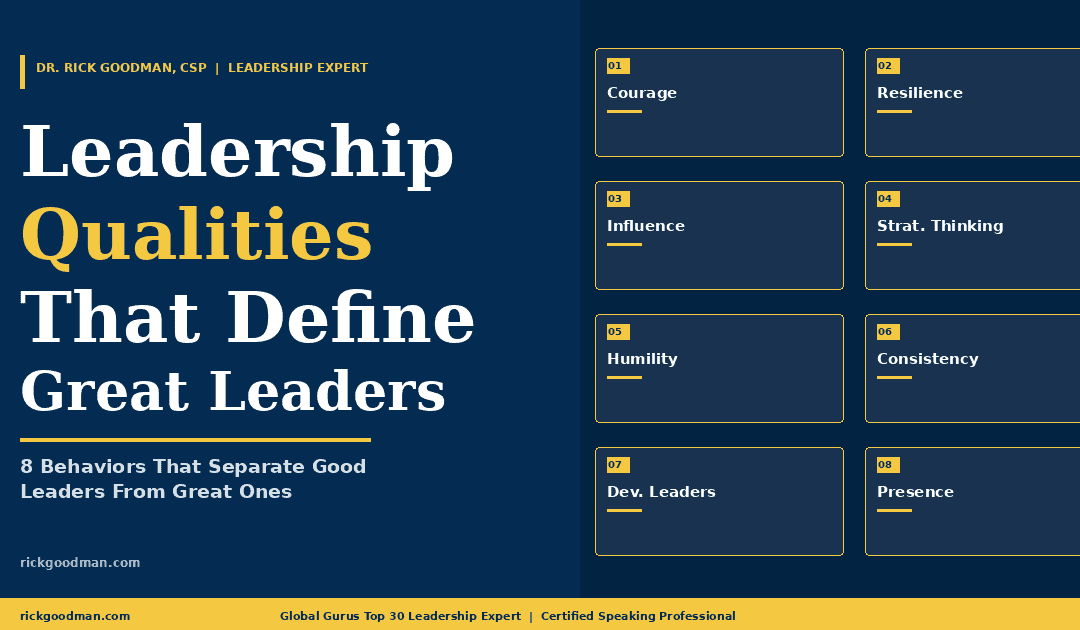
Good leaders are not hard to find. However, leaders who perform when conditions are difficult are rare. They step up when the decision is unpopular, the team is watching, and the pressure is real. The leadership qualities that define great leaders are not about natural talent or charisma. Instead, they are specific, learnable behaviors that show up consistently at the moments that matter most.
After more than 30 years coaching executives and delivering keynote programs to organizations across 32 countries, the qualities that separate good from great are remarkably consistent and remarkably teachable.
This article covers eight leadership qualities that go beyond the foundational list. Together, these behaviors define leaders who build lasting organizations and develop other leaders. They also produce results that outlast their direct involvement. For the core foundational qualities every leader needs first, start with The Core Leadership Qualities That Drive Organizational Performance.
Leadership Qualities Beyond the Basics
Why Great Leadership Qualities Show Up Under Pressure
Anyone can lead well when conditions are favorable. The budget may be approved, the team aligned, and the market cooperative. However, great leadership qualities do not show up only in those moments. They surface when the plan fails or the decision is unpopular. They also appear when the team is depleted and the easy path is available but wrong.
What Separates Consistent High Performers
The organizations I have worked with consistently outperforming their peers do not always have more resources or better circumstances. Instead, they have leaders who bring specific qualities to the hardest moments. High performance is not simply a function of favorable conditions. Ultimately, it reflects what leaders do when conditions are anything but favorable.
"Anyone can lead when conditions are easy. Leadership qualities that define great leaders only reveal themselves when the conditions are not."
The Eight Leadership Qualities That Separate Good from Great
Quality 01Courage: Making the Hard Call When It Is Unpopular
Courage is the leadership quality that makes all other qualities meaningful. A leader can have exceptional strategic thinking, strong communication skills, and genuine care for the team. However, none of it matters if that leader fails to act when a decision requires an unpopular stand.
Courageous leadership means delivering difficult feedback before a problem becomes a crisis. It means advocating for a strategic direction when the data supports it and the politics do not. Holding someone accountable when it would be easier to look the other way is also courage in practice.
The absence of courage does not eliminate these situations. Without it, they simply get worse before they get addressed.
Leaders who model courage give their teams explicit permission to do the same. As a result, high-performance organizations build a culture of candor. That culture starts with one leader willing to say what needs to be said to the people who need to hear it.
Quality 02Resilience: Leading Others Through Failure and Setback
Resilience is not the ability to avoid setbacks. Instead, it is the ability to lead others through them without losing clarity, composure, or direction. Every organization faces failure. What determines whether failure becomes a turning point or a breaking point is often the resilience of the leader.
Resilient leaders process setbacks without projecting panic onto their teams. At the same time, they acknowledge what went wrong and maintain forward momentum. Then they extract the learning and deliberately rebuild confidence in the path ahead.
Rather than assigning blame and retreating, they treat setbacks as information and respond with ownership and action. That is the solutions-oriented leadership framework in practice. For more on that framework, see the five traits of a solutions-oriented leader.
Quality 03Influence Without Authority: Moving People Who Do Not Report to You
The higher a leader rises in an organization, the more results depend on people outside the reporting line. That includes cross-functional partners, board members, external stakeholders, and peer leaders. Therefore, influence without positional authority becomes one of the most consequential executive leadership qualities.
Leaders who influence without authority rely on three consistent behaviors. First, they build genuine relationships before they need anything. Second, they frame requests around shared goals rather than personal gain. Finally, they follow through on commitments so their word carries weight in every room.
Ultimately, whether a leader's impact stays within their reporting line or extends across the entire organization comes down entirely to this quality.
Bring Dr. Rick Goodman to your next conference or leadership retreat to develop the leadership qualities that drive real organizational performance.
Check Dr. Rick's AvailabilityStrategic Thinking: Seeing Around Corners, Not Just Managing the Present
Strategic thinking separates leaders who manage what exists from leaders who build what comes next. Specifically, it requires looking beyond the immediate quarter. Great leaders identify the forces shaping the operating environment and position the organization to respond before those forces become crises.
In contrast, strategic leaders ask different questions than operational leaders. Where operational leaders ask how to execute better today, strategic leaders ask what today's execution is building toward and whether that destination still makes sense.
In practice, strategic leaders scan the competitive landscape and read early signals of disruption. They also make resource decisions based on where the environment is heading, not where it has been.
This quality connects directly to adaptive leadership. Organizations that hold together under disruption are rarely led by people who planned perfectly. Instead, they are led by people who saw change early enough to move through it rather than simply react. For a deeper look at that connection, see the full guide on adaptive leadership vs traditional leadership.
Quality 05Humility: The Quality That Makes All Others Sustainable
Humility is the most underrated leadership quality on this list and the one most responsible for long-term effectiveness. Leaders who operate with genuine humility do not confuse confidence with certainty.
They acknowledge what they do not know, give credit to the people around them for results they helped create, and stay genuinely open to perspectives that challenge their own.
Importantly, humility is not weakness. It is precision. Humble leaders use their knowledge and authority where it adds value, then step aside elsewhere. As a result, they build organizations where the best idea can win regardless of its source.
The practical output of humility is a team that brings its best thinking to the leader rather than protecting itself from them. That organizational advantage costs nothing to create and compounds steadily over time.
Quality 06Consistency: The Leadership Quality Most Responsible for Trust
Consistency is the most overlooked leadership quality in most development conversations and the one with the most direct impact on team trust. Heavy investment goes into developing vision, communication, and strategic thinking. What makes all of those effective is showing up the same way every day, especially on the days when doing so is hardest.
Teams watch what leaders do far more than what they say. When behavior shifts with mood or standards apply selectively, trust erodes. Likewise, trust falls when accountability disappears under pressure, regardless of a leader's other strengths.
Consistent behavior compounds trust instead. People know what to expect, and that predictability creates the psychological safety that drives performance.
Closing the Gap Between Values and Behavior
Consistent leaders align what they say with what they do. They do not declare accountability from the stage and avoid hard conversations in private. They do not champion innovation in all-hands meetings and punish failure in one-on-ones.
That alignment between word and action is what makes leadership credible. It is what makes consistency the foundation beneath every other quality on this list.
"Trust is not built in the moments of vision and inspiration. It is built in the ordinary moments when a leader does exactly what they said they would do."Quality 07
Developing Other Leaders: Building the Organization Beyond Yourself
Good leaders develop people. Great leaders develop other leaders. The distinction matters because it determines whether the organization's performance depends on one person's presence or is built into the DNA of the entire team.
Leaders who develop other leaders do not hoard knowledge as a competitive advantage. Instead, they identify high-potential people and stretch them into situations where real leadership is required.
They provide consistent feedback and support that accelerates growth, and they measure their own success not just by personal output but by the leadership capacity they leave behind.
In the end, this quality separates leaders who build legacies from those who build dependencies. Organizations that outperform competitors over time usually develop leadership capacity early. Their leaders make that work a priority before it becomes strategically convenient.
Quality 08Presence: Commanding Attention When It Matters Most
Leadership presence is not charisma, and it is not extroversion. Instead, it makes people orient toward a leader because experience has taught them it is worth listening. Presence grows through the consistent demonstration of every quality on this list.
Leaders with strong presence are fully in the room. For example, phones, next meetings, and internal monologues do not compete for their attention. Their communication is clear and specific rather than hedged or qualified. Moreover, composure under pressure signals that the situation is manageable.
Presence is ultimately the outward expression of inner clarity. Leaders who know who they are, what they stand for, and what they are building project that clarity into every room they enter. Commanding attention without demanding it is what that actually looks like.
How These Leadership Qualities Work Together
The System Behind the List
These eight qualities do not operate in isolation. For example, courage without humility becomes arrogance. Likewise, resilience without consistency becomes erratic recovery. Presence without strategic thinking becomes performance without direction. Consequently, effective leaders develop these qualities as a connected system rather than individual checkboxes.
Developing one quality almost always strengthens the others. For instance, genuine humility tends to grow influence without authority. Consistency also strengthens presence in the room. Meanwhile, a sharper strategic lens increases the courage to act on what it reveals. Over time, the system builds on itself.
Where to Start
The entry point is honest self-assessment. First, identify the quality that would most change your impact as a leader. From there, use focused practice, the right feedback, and repeated application under pressure. That is how great leadership qualities become permanent rather than situational.

About Dr. Rick Goodman, CSP
Dr. Rick Goodman is a Certified Speaking Professional, six time Global Gurus Top 30 Leadership Expert (2021 to 2026), and author of five books including the Amazon number one bestseller The Solutions Oriented Leader.
In addition, he has delivered more than 2,000 programs across all 50 states and 32 countries. His work helps executives, leadership teams, and organizations develop the specific leadership qualities that drive measurable results.
His keynote programs and executive coaching engagements are customized, immediately actionable, and built from 30 years of real world leadership development.
Book Dr. Rick GoodmanContinue Building Your Leadership Foundation
- The Core Leadership Qualities That Drive Organizational Performance
- Adaptive Leadership vs Traditional Leadership: Why the Old Playbook Breaks Under Pressure
- Five Traits of a Solutions-Oriented Leader
- How Leaders Build Trust
- The Adaptability Zone Keynote Program
- Solutions Oriented Leader Workshop
- Leadership Workshops and Corporate Training
Watch: Leadership Qualities That Actually Drive Results
Dr. Rick Goodman breaks down the leadership qualities that produce measurable organizational performance, including ownership, communication, and the solutions-oriented mindset that turns these qualities into results on your team.
Develop the Leadership Qualities That Drive Real Results
Dr. Rick Goodman works with executives, leadership teams, and organizations to develop the specific leadership qualities that build high-performance cultures and sustain results over time. His programs are customized, immediately actionable, and delivered across 32 countries.
Recognized six consecutive years as a Global Gurus Top 30 Leadership Expert. Author of five books. Certified Speaking Professional.
Book Dr. Rick GoodmanLeadership Qualities: Questions Leaders and Organizations Ask Most
Common Questions About Developing Great Leadership Qualities
If your question is not answered below, call us at 1-954-218-5325 or email rick@rickgoodman.com.
The most important leadership qualities are the ones that produce results when conditions are difficult. Courage, resilience, consistency, and the ability to influence without authority consistently separate leaders who build lasting organizations from those who plateau. None of these qualities are fixed traits. Each one is a learnable behavior that improves with deliberate practice and the right feedback.
Executives need strategic thinking, the ability to influence without formal authority, and the humility to build leadership capacity in others rather than centralizing decision-making at the top. Resilience and consistency are also critical at the executive level because the entire organization watches how senior leaders behave under pressure and calibrates its own behavior accordingly.
Leadership qualities are developed, not discovered. Every quality on this list, from strategic thinking to humility to presence, can be built with the right focus, practice, and feedback. Those who make the greatest gains are not always the most naturally gifted. What separates them is a commitment to identifying their highest-leverage development area and improving it consistently.
Leadership skills are specific competencies like communication, delegation, or conflict resolution. By contrast, leadership qualities are the character-based behaviors and mindsets that determine how those skills get applied. A leader can have strong communication skills but lack the courage to deliver a difficult message. Skills are the tools. Qualities determine whether those tools get used when it actually matters.
Leadership qualities directly determine the culture a team operates in, and culture determines performance. A leader who models consistency builds a team where accountability is the norm. Demonstrating humility, by contrast, builds a team where candor is safe. When a leader shows courage under pressure, the team learns it is safe to take the risks that drive growth. Every quality a leader demonstrates, or fails to demonstrate, shapes what the team around them believes is acceptable, expected, and possible.
Consistency is the most overlooked and underrated leadership quality. Although leaders invest heavily in vision, communication, and strategic thinking, consistency makes those strengths effective. In practice, teams watch what leaders do far more than what they say. When behavior is inconsistent, trust erodes. When behavior is consistent, trust compounds and performance follows.
Developing leadership qualities across an organization starts with honest assessment of where the gaps are, followed by targeted development experiences that build the specific qualities your leadership team needs most. Dr. Rick Goodman works with organizations to identify those gaps and deliver keynote programs, workshops, and executive coaching that build the leadership qualities that drive measurable results.
Dr. Rick Goodman's programs focus on the leadership qualities that produce measurable organizational results: solutions-oriented thinking, accountability, adaptability, influence, resilience, and the ability to build high-performance teams. His keynote programs, workshops, and executive coaching engagements are built around these qualities and delivered to organizations across 32 countries. To learn more, visit the booking calendar or call 1-954-218-5325.