
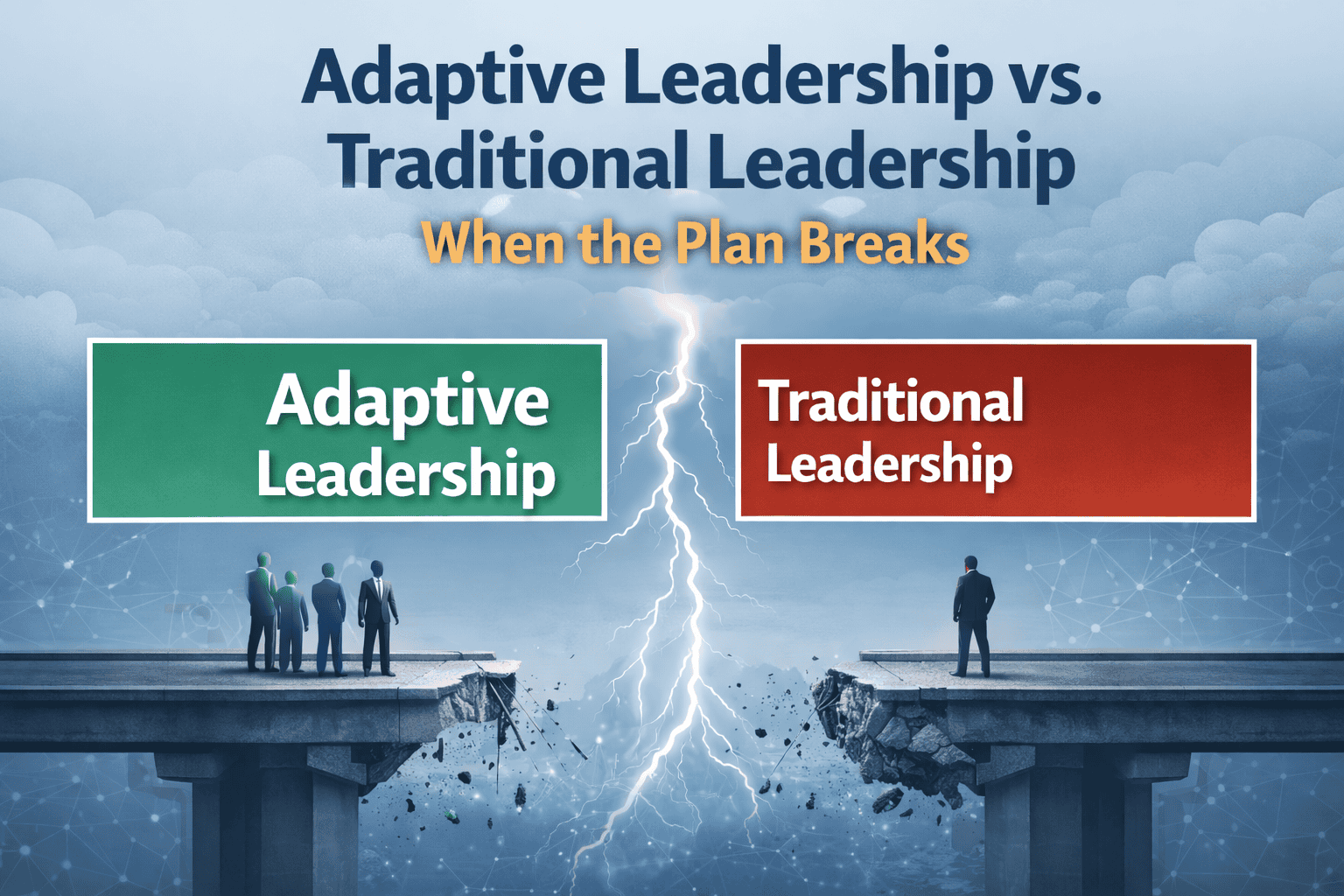
Traditional leadership works when the environment is stable and the answers are known. When uncertainty becomes the operating condition, leaders who default to control, compliance, and pre-set plans do not just underperform. They slow down every person around them. Adaptive leadership vs. traditional leadership is not a debate between two philosophies. It is a diagnostic question every leader needs to answer honestly about how they actually show up when the plan breaks.
After more than 30 years coaching executives and delivering keynote programs across all 50 states and 32 countries, I have seen this play out in every industry. The leaders who build organizations that hold together under pressure are not the ones with the most authority. They are the ones who learned when to lead differently.
This article is part of the Adaptive Leadership series. If you have not read the pillar piece yet, start here: Adaptive Leadership: Turning Disruption Into Advantage.
What Traditional Leadership Gets Right
Traditional leadership is not a failed model. It is a situational one. For decades, leadership development built around a stable operating assumption: if leaders plan well, maintain clear authority, and drive consistent execution, organizations will perform.
The Conditions Where Traditional Leadership Thrives
That assumption holds up in conditions where:
- The problem is clearly defined
- The solution is already known
- Authority can produce reliable results
- The environment changes slowly enough for plans to stay relevant
In those conditions, traditional leadership is efficient. Structure reduces confusion. Clear hierarchy accelerates decision-making. Consistent standards build predictable execution. The mistake is not using traditional leadership in stable environments. The mistake is continuing to use it after the environment changes.
Why the Situation Determines the Style
When leaders weigh adaptive leadership vs traditional leadership, the most important variable is not personality or preference. It is the operating environment. Leaders who read the situation accurately and match their style to it consistently outperform those who default to one approach regardless of context. That situational awareness is the foundation of every high-performing leadership culture I have built with clients across 32 countries.
"Traditional leadership is not wrong. It is situational. The leaders who struggle are the ones who have not figured out which situation they are actually in."
Adaptive Leadership vs. Traditional Leadership: Side by Side
The differences between adaptive and traditional leadership styles are not abstract. They show up in daily decisions, in how problems get solved, and in how teams respond when pressure increases. This comparison covers the dimensions that matter most in practice.
| Dimension | Traditional Leadership | Adaptive Leadership |
|---|---|---|
| Decision-making | Centralized at the top; leaders decide, teams execute | Distributed; authority pushed to where the expertise lives |
| Response to uncertainty | Waits for certainty before committing to a direction | Creates clarity and momentum when certainty is not available |
| Problem type | Best suited to technical problems with known solutions | Built for adaptive challenges where leaders must discover solutions in real time |
| Authority basis | Positional authority and role hierarchy | Trust, engagement, and shared responsibility |
| Planning approach | Leaders treat detailed plans as reliable roadmaps | Leaders treat plans as hypotheses and update them based on feedback |
| Team role | Execute assigned tasks within defined structure | Think, challenge assumptions, and own outcomes |
| Response to failure | Assign accountability; analyze deviation from the plan | Extract learning; update the approach and move forward |
| Speed under pressure | Slows as complexity increases; decisions bottleneck at the top | Accelerates; distributed decision-making keeps the organization moving |
| Cultural output | Compliance; people do what they are told | Commitment; people act because they understand why it matters |
Bring Dr. Rick Goodman to your next conference or leadership event to deliver The Adaptability Zone keynote, the framework your leaders need to perform when plans break and certainty disappears.
When Traditional Leadership Fails
Traditional leadership does not fail slowly. It fails at exactly the moments when organizations need leadership most. Here is what that looks like in practice.
When Problems Are Ill-Defined
Traditional leadership relies on clear problem statements. When the problem itself is shifting, leaders who default to structured analysis and pre-approved solutions find themselves solving the wrong problem with the right tools. The organization moves, but not in the right direction.
When Expertise Is Distributed, Not Centralized
The assumption behind traditional leadership is that the person at the top has the best answers. In complex, fast-moving organizations, that assumption breaks down fast. The people closest to the customer, the process, or the technology often have the most relevant information. When authority sits too far from expertise, decision quality suffers and execution slows.
When Speed Is a Competitive Requirement
If every decision must travel up the hierarchy before it can move forward, the hierarchy becomes the bottleneck. Organizations that rely on traditional leadership in fast-moving markets consistently lose ground to competitors that have pushed authority closer to the work.
When Compliance Is Mistaken for Commitment
Teams operating under traditional leadership often comply without committing. They execute assigned tasks but do not generate initiative, flag early warning signals, or go beyond the minimum. Leaders who mistake quiet compliance for high engagement are consistently caught off guard when performance plateaus or talent walks out.
When Change Is Constant
Traditional leadership is optimized for a stable environment. In an environment where the landscape shifts quarterly, the leaders, processes, and cultures built for stability become liabilities. The organization's greatest strength in calm conditions, its structure and consistency, becomes its greatest vulnerability under sustained change.
How Leaders Build Adaptive Teams
Building an adaptive team is not a cultural initiative or a training program. It is the product of specific leadership behaviors practiced consistently over time. Here is what that actually requires.
1. Create Psychological Safety at the Team Level
Adaptive teams raise problems early, challenge bad assumptions, and try new approaches without waiting for permission. That behavior only happens when people believe it is safe to do so. Psychological safety is not a soft condition. It is the prerequisite for every adaptive behavior that follows.
Leaders build it by responding to candor with curiosity instead of defensiveness and by protecting the people who deliver difficult truths. When people see that speaking up earns respect rather than penalties, adaptive behavior becomes the team's operating standard rather than the exception.
2. Distribute Decision-Making Authority Deliberately
Push authority to the level where the expertise lives. Define clearly which decisions require leader approval, which require consultation, and which the team can make autonomously. When people know the boundaries, they operate confidently inside them. When boundaries are unclear, everything defaults upward and the leader becomes the bottleneck.
3. Replace Blame with Ownership
The fastest way to destroy adaptive capacity is to respond to failure with blame. Blame teaches people to avoid risk, hide problems, and protect themselves instead of the mission. Ownership teaches people that the goal is to fix the situation and learn from it.
This mindset sits at the core of solutions-oriented leadership. It creates the cultural condition that sustains adaptive behavior over time. For more on this framework, see the five traits of a solutions-oriented leader.
4. Build Continuous Learning Into the Operating Rhythm
Adaptive teams treat every significant outcome, whether a win or a miss, as a learning event. Brief structured reviews after key milestones, honest conversations about what worked and what did not, and deliberate integration of those lessons into the next cycle are how adaptive capacity compounds over time.
5. Model the Behaviors You Need
Leaders who ask for candor but respond defensively when they receive it will not get candor for long. Leaders who ask for risk-taking but punish failure will not get risk-taking for long. Adaptive teams are built by adaptive leaders who visibly demonstrate the behaviors they ask from others, especially under pressure when the temptation to revert to control is highest.
"You cannot build an adaptive team with traditional leadership behaviors. The culture your team operates in is the exact culture your behavior creates."
The Adaptability Zone: Moving Beyond Traditional Leadership Into Adaptive Practice
The Adaptability Zone is the leadership framework I developed from 30 years of working with executives inside organizations navigating real disruption, not case studies, but live conditions where the stakes were high and the answers were not obvious.
What the Framework Actually Solves
The framework addresses a gap that the adaptive leadership vs traditional leadership debate does not fully resolve: knowing that you need to lead differently is not the same as knowing how. The Adaptability Zone gives leaders a practical operating system for maintaining clarity, momentum, and team performance when uncertainty is the norm rather than the exception.
It connects directly to the work of building solutions-oriented teams, eliminating the decision bottlenecks that traditional leadership creates, and establishing the cultural conditions where adaptive behavior becomes the default. You can explore the full keynote and workshop framework here: The Adaptability Zone.

About Dr. Rick Goodman, CSP
Dr. Rick Goodman is a Certified Speaking Professional, six-time Global Gurus Top 30 Leadership Expert (2021 to 2026), and author of five books including the Amazon number one bestseller The Solutions Oriented Leader. He has delivered more than 2,000 programs across all 50 states and 32 countries, working with Fortune 500 companies, major associations, and healthcare organizations to build leaders who perform when conditions change.
His keynote program The Adaptability Zone is built specifically for organizations navigating uncertainty, disruption, and rapid change.
Continue Building Your Leadership Foundation
- Adaptive Leadership: Turning Disruption Into Advantage
- Adaptive Leadership in Action: Real World Examples of Turning Disruption Into Growth
- Building an Adaptive Leadership Culture
- Regulating the Heat: How Adaptive Leaders Manage Tension Without Burnout
- Organizational Resilience: How Psychological Safety Helps Teams Adapt
- Leading Through Uncertainty Without Losing Alignment
- The Adaptability Zone Keynote Program
- Leadership Qualities That Define Effective Leaders
- Five Traits of a Solutions-Oriented Leader
- How Leaders Build Trust
- Solutions Oriented Leader Workshop
- Leadership Workshops and Corporate Training
Watch: Adaptive Leadership in Action — Real World Examples
Dr. Rick Goodman walks through real world examples of adaptive leadership turning disruption into competitive advantage. See exactly how the principles in this article play out inside organizations under pressure.
Bring Adaptive Leadership to Your Next Event
Dr. Rick Goodman delivers The Adaptability Zone keynote to associations, Fortune 500 companies, healthcare organizations, and industry groups that need their leaders performing at the highest level when conditions shift. His programs are customized, immediately actionable, and built from 30 years of real-world leadership development across 32 countries.
Recognized six consecutive years as a Global Gurus Top 30 Leadership Expert. Author of five books. Certified Speaking Professional.