
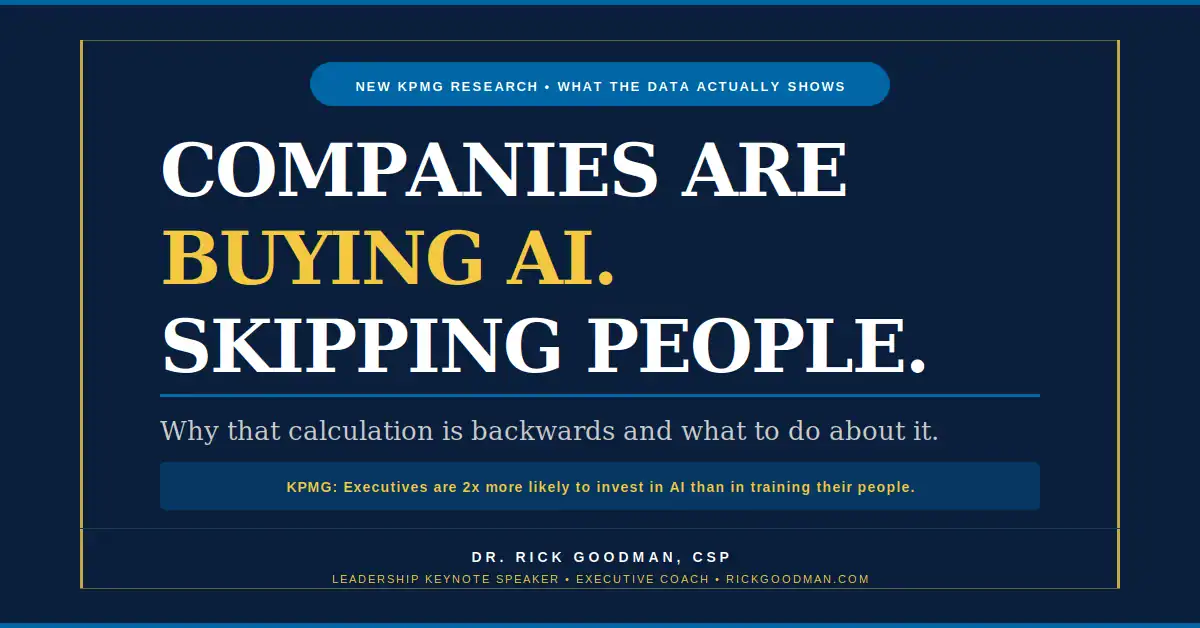
A new KPMG report confirms what I have been saying from stages across 32 countries for more than 30 years. Organizations dramatically overspend on technology and dramatically underspend on leadership training investment, the one commitment that actually drives performance. Their people.
The numbers tell a clear story. Specifically, KPMG research shows executives are twice as likely to invest in new technology. They are far less likely to invest in training employees. 57% of business leaders named improving performance and efficiency as a top priority. Yet fewer than 10% named developing stronger leadership training programs as a top objective.
That gap between what organizations claim to want and where they direct their money is not a minor oversight. Instead, it actively costs them the very results they are chasing.
The KPMG Finding Every Executive Needs to Hear
KPMG Deputy Chair Atif Zaim stated it plainly: new tools alone do not drive performance. In fact, his firm's research shows technology investments consistently fall flat. This happens when organizations skip the investment in human skills those tools require.
The report makes an even sharper point. Specifically, firms that neglect developing their people to maximize new tools frequently fail to realize their full value. As a result, the AI investment your board just approved may deliver only a fraction of its projected return. Without a parallel leadership training investment, adoption simply will not succeed.
Organizations that recognize this distinction now will hold a meaningful advantage. Meanwhile, those that recognize it after the fact will be playing catch-up.
Why Technology Investments Keep Falling Flat
I have worked with organizations across every major industry for more than three decades. Consistently, the pattern KPMG now documents with data plays out on the ground.
A leadership team spots a performance gap and approves a technology purchase to close it. The software deploys. Six months later, adoption sits low, productivity gains never materialize, and leadership grows frustrated. So they buy different technology, and the cycle repeats.
What almost never faces honest examination in that cycle is the leadership layer itself. Three questions rarely get asked. Do managers clearly communicate the purpose of new tools? Do employees receive genuine development to use them? Does the culture support the continuous learning that real adoption demands?
"Technology does not change behavior. Leadership does. Without a deliberate leadership training investment alongside every major technology initiative, you are buying a high-performance engine. Then you are putting it in a car with no steering wheel."
Every technology rollout Rick has seen succeed shares one trait: leadership development ran alongside it, not after it.
Explore the Leadership Training WorkshopThe Real Cost of Underspending on Leadership Training
KPMG data reveals that 81% of executives report their boards have raised expectations around organizational adaptability. That expectation makes sense. The business environment now moves faster than at any point in history, and adaptability qualifies as a baseline survival requirement.
Adaptability does not come from technology. Instead, it comes from people, specifically leaders at every level. These leaders guide their teams through uncertainty, communicate clearly during disruption, and develop their people continuously.
Why a One-Time Leadership Training Investment Is Not Enough
KPMG calls for continuous learning built into the fabric of the company. This is not a periodic program. It is a cultural operating standard. That kind of shift requires leaders who model learning themselves and create the psychological safety that makes growth possible. No software deployment produces that outcome on its own.
Organizations that build this culture will navigate the next wave of disruption most effectively. By contrast, those that keep reaching for technology as the primary solution will keep watching their expensive tools underdeliver.
Adaptability Is a Leadership Training Outcome
Zaim's conclusion from the KPMG research makes the stakes clear: adaptability is a recipe. Specifically, it comes from aligning how organizations work, how they develop people, and how decisions get made.
Every element of that recipe reflects a leadership training outcome. For instance, how organizations work reflects the daily decisions of their leaders. Likewise, the way they develop people depends on their managers' coaching skills and mandate to invest in their teams. In turn, how decisions get made reflects leadership development quality at every level of the hierarchy.
The companies pulling ahead right now move beyond isolated fixes to disciplined, coordinated execution. That coordination requires leaders who meet current demands. It does not reward leaders who performed well five years ago and have simply coasted since. Above all, it requires leaders who receive genuine, ongoing investment and grow continuously alongside the organizations they serve.
What the Right Investment Balance Actually Looks Like
This is not an argument against technology investment. AI and the tools it powers are genuinely transformative, and organizations that ignore them will fall behind. Rather, the KPMG data makes a case for balance, not retreat.
Every significant technology investment should pair with a deliberate human development investment. Specifically, that means three things. First, executive coaching programs for the managers driving adoption. Second, workforce development that builds the specific skills employees need to use new tools. Third, a cultural investment in continuous learning that makes adaptation a habit rather than a crisis response.
Organizations that achieve this balance compound their technology returns rather than chase projections that never materialize. Conversely, those that treat leadership training as a cost to minimize will keep wondering why their expensive technology underperforms.
"The KPMG data makes the case clearly. The only question is whether your organization acts on it before or after your competitors do."
Where to Start With Your Leadership Training Investment
If your organization has been overinvesting in technology and underinvesting in leadership development, start with an honest assessment. Specifically, identify where your leadership gaps actually sit. Then determine which development investments would produce the greatest return against your specific performance priorities.
Rick offers three ways to close that gap. A leadership keynote reframes how your executive team thinks about the people investment. A leadership training workshop builds skills through real application. Executive coaching develops your senior leaders against their specific performance priorities. Whichever path fits, the conversation starts with one decision: invest in the people who drive everything else.

Continue Reading
Ready to Make the Right Investment in Your Leadership Team?
Dr. Rick Goodman works with organizations across the country to close the gap between technology investment and human performance. Keynotes, workshops, and executive coaching programs that produce measurable results.
Book Dr. Rick Goodman