
Leadership Skills for Managers: 5 Skills Every Leader Needs
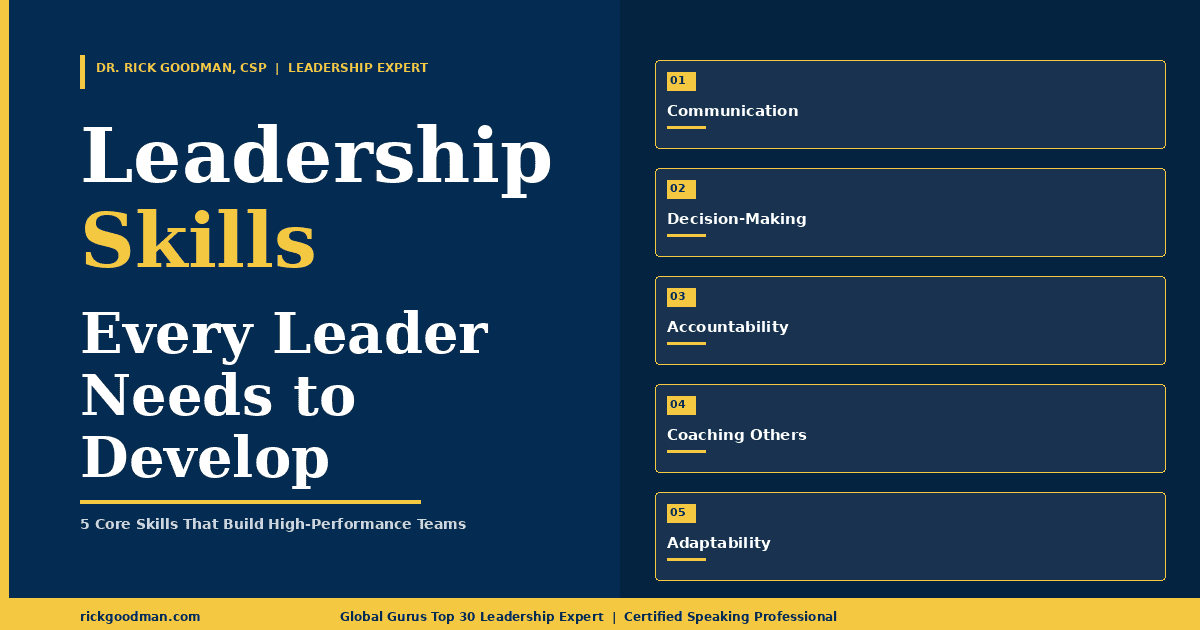
Leadership skills for managers do not develop automatically after a promotion. The abilities that make someone a strong individual contributor are different from the competencies required to lead people. Managers have to learn how to communicate clearly, make decisions, create accountability, coach others, and adapt when conditions change.
This article focuses on practical leadership competencies managers can develop through deliberate practice. For the character based behaviors behind those competencies, including integrity, courage, empathy, and consistency, see Effective Leadership Qualities: 10 Qualities of Great Leaders.
Why Leadership Skills for Managers Must Be Developed Deliberately
Organizations often promote high performers and assume leadership will follow naturally. It rarely does. A strong salesperson may know how to sell but not how to coach another salesperson. A great engineer may solve complex technical problems but still struggle to delegate, communicate priorities, or give corrective feedback.
Experience alone does not fix those gaps. If a manager practices the same weak communication pattern for five years, year six does not automatically make it stronger. Leadership skills improve when managers practice intentionally, receive feedback, and adjust.
"Leadership is not a title someone grows into automatically. It is a set of skills that gets stronger through practice, feedback, and real responsibility."
5 Core Leadership Skills Every Manager Needs
Skill 01Communication: Creating Clarity and Alignment
Communication is one of the most important leadership skills for managers because every other responsibility depends on it. Managers communicate goals, priorities, expectations, feedback, change, and decisions. When those messages are unclear, execution slows down.
Strong leadership communication combines clarity with listening. Managers need to explain what must happen and why it matters, while also creating enough space to hear concerns, questions, and information from the people closest to the work.
How to Practice This Skill
- End important conversations by confirming who owns what and by when.
- Ask employees to summarize priorities in their own words when alignment matters.
- Separate facts, assumptions, and decisions during periods of uncertainty.
- Listen for what is not being said, not only what is said directly.
Decision Making: Moving Forward Without Perfect Information
Managers are responsible for moving work forward. Strong decision making means gathering the right information, consulting the right people, understanding the consequences, setting a decision point, and committing to a direction.
Good decision making is not the same as making every decision quickly. The skill is knowing when additional information will materially improve the decision and when waiting simply creates delay.
How to Practice This Skill
- Define the decision before collecting more information.
- Identify what must be known versus what would merely be nice to know.
- Set a decision deadline when delay has a cost.
- Create a review point when the decision may need adjustment later.
Bring Dr. Rick Goodman to your organization to build practical leadership skills managers can apply immediately.
Accountability: Turning Expectations Into Follow Through
Accountability requires two things: clear expectations and consistent follow through. People need to know what they own, what success looks like, when the work is due, and what happens next.
Managers weaken accountability when expectations remain vague or when missed commitments have no follow up. Strong managers address gaps directly while keeping the conversation focused on behavior, responsibility, and the path forward.
How to Practice This Skill
- Define ownership before work begins.
- Use specific deadlines rather than vague timing.
- Address missed commitments close to the event.
- Apply standards consistently across the team.
Coaching and Developing Others: Multiplying Your Impact
The best managers do more than direct work. They improve the capability of the people doing the work. Coaching requires resisting the urge to solve every problem yourself and helping employees strengthen their own judgment.
That does not mean withholding useful expertise. It means knowing when to provide an answer and when to ask a question that helps another person think more clearly.
How to Practice This Skill
- Ask what the employee has already considered before giving your answer.
- Give feedback that is specific enough to act on.
- Use stretch assignments with clear boundaries and support.
- Review lessons after important projects instead of moving immediately to the next one.
Adaptability: Leading When the Plan Has to Change
Adaptability has become one of the most important management leadership skills because priorities, technology, markets, and customer expectations can change faster than traditional planning cycles.
Adaptive managers do not change direction randomly. They stay clear on the goal while adjusting the method when new evidence shows the current approach is no longer working.
How to Practice This Skill
- Separate the goal from the current method.
- Ask what new information has changed the situation.
- Run small experiments when the correct answer is not yet clear.
- Explain why the approach is changing so the team does not confuse adaptation with inconsistency.
For a deeper framework on leading through change, see Adaptive Leadership: Turning Disruption Into Competitive Advantage.
Watch: Leadership Skills That Get Results
Dr. Rick Goodman breaks down practical leadership behaviors and how they show up in real organizational performance.
How to Improve Leadership Skills as a Manager
Leadership skills development works best when managers focus on one or two behaviors at a time. Awareness matters, but behavior changes through application.
- Choose the skill creating the biggest performance gap. Start where improvement will matter most.
- Define a specific behavior. Replace vague goals such as "communicate better" with an observable action.
- Practice in a real situation. Skills strengthen under actual conditions.
- Get direct feedback. Ask what changed and what still creates friction.
- Review and repeat. Improvement comes from a feedback loop, not a one time event.
Leadership Skills Training for Managers
Leadership skills training can accelerate development when the program is connected to the actual challenges managers face. Generic information may create awareness, but useful training gives people a framework, a chance to practice, feedback, and a clear expectation for application afterward. The Center for Creative Leadership has long emphasized that leadership development improves when learning is connected to experience, feedback, and real world application.
The most effective programs connect training to real work. A manager should leave knowing what behavior to practice next, where to practice it, and how progress will be evaluated.
When Training Is the Right Format
Training works well when a group of managers needs a shared language, common framework, or consistent approach to communication, accountability, decision making, and coaching.
When Coaching Is the Better Fit
Coaching is useful when the leadership challenge is highly individual, sensitive, or tied to a specific executive role. It gives a leader more depth, direct feedback, and accountability around a personal development goal.
For individual development, see Executive Coaching Services. For team development, explore the Solutions Oriented Leader Workshop.
Leadership Skills vs Leadership Qualities
Leadership skills are competencies managers practice. Leadership qualities describe the character and mindset behind those competencies. Communication is a skill. Integrity is a quality. Coaching is a skill. Empathy is a quality. Decision making is a skill. Courage and consistency influence how that skill is used.
Managers need both. For the companion guide, read Effective Leadership Qualities: 10 Qualities of Great Leaders.

About Dr. Rick Goodman, CSP
Dr. Rick Goodman is a Certified Speaking Professional and Global Gurus Top 30 Leadership Expert who has delivered more than 2,000 programs across all 50 states and 32 countries. He is the author of five books, including the Amazon number one bestseller The Solutions Oriented Leader.
His keynote programs, workshops, leadership retreats, and executive coaching engagements help leaders turn concepts into practical behavior.
Continue Building Your Leadership Foundation
- Effective Leadership Qualities
- How Leaders Build Trust
- Consistent Leadership
- Organizational Resilience
- Adaptive Leadership
- Solutions Oriented Leader Workshop
- Leadership Workshops and Corporate Training
Build the Leadership Skills Your Managers Need Most
Dr. Rick Goodman delivers keynotes, workshops, leadership retreats, and executive coaching programs built around the real leadership challenges your managers face.