
What’s the Difference Between a Boss and a Leader?
Boss vs Leader: 7 Differences That Define Great Leadership
The boss vs leader difference is not simply about title or authority. It is about impact. Bosses tend to rely on control. Leaders build trust, clarity, accountability, and confidence in the people around them.
Most people have worked for both. As a result, we usually recognize the difference quickly. A boss may direct the work, enforce rules, and focus on compliance. A leader still sets standards and expects results, but also coaches people, creates ownership, and helps the team understand why the work matters.
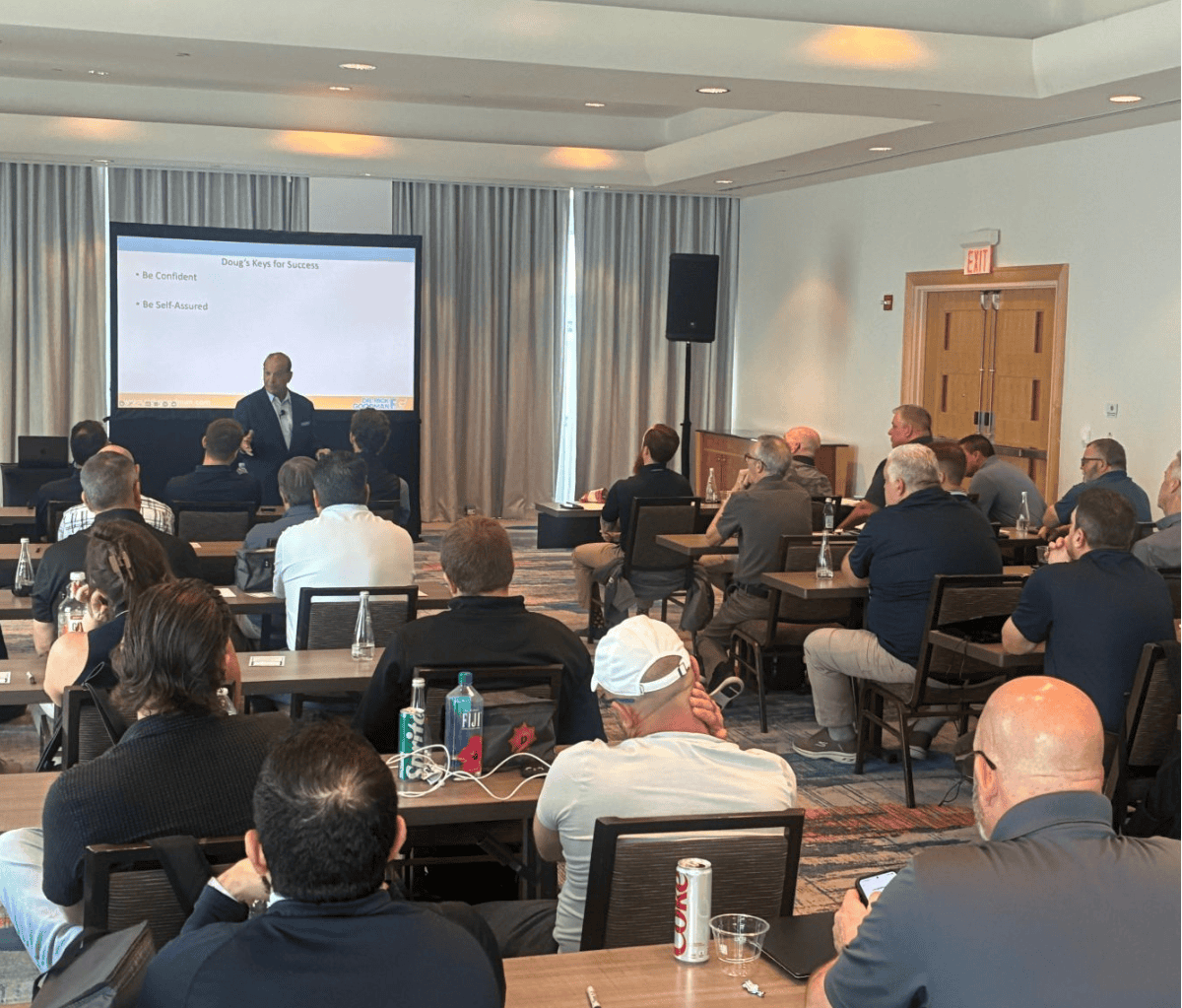
After more than 30 years working with leaders and organizations around the world, I have seen how the boss vs leader distinction affects culture, engagement, retention, decision making, and performance. The good news is that the gap is behavioral. Therefore, managers can learn to become stronger leaders.
What Is the Difference Between a Boss and a Leader?
A boss primarily manages through positional authority. A leader influences people through trust, example, communication, and shared purpose. Strong leaders still make difficult decisions and hold people accountable. However, they do it in a way that develops capability rather than dependence or fear.
Boss vs Leader: 7 Key Differences
These seven differences show how a leadership mindset changes everyday management behavior. In other words, the real leader vs boss question is not about job titles. It is about how you communicate, make decisions, develop people, and respond when pressure rises.
1. Leaders Lead From the Front
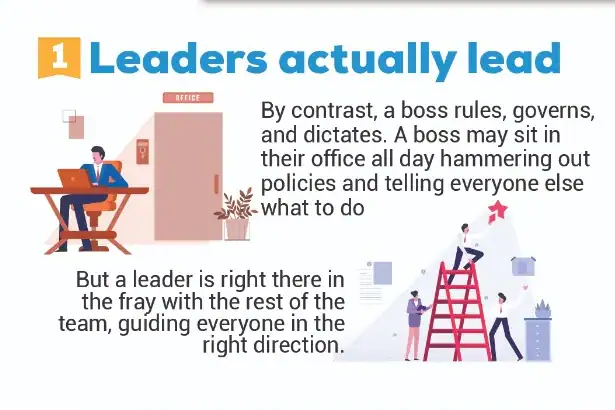
A boss can rely on position and simply issue directives. A leader sets the standard through behavior. That means being visible, removing obstacles, taking responsibility, and demonstrating the level of effort and professionalism expected from the team.
Consequently, people know where they stand because the leader's actions match the expectations being communicated. Leadership is not simply the position you hold. It is the standard you consistently model.
2. Leaders Listen Before They Speak
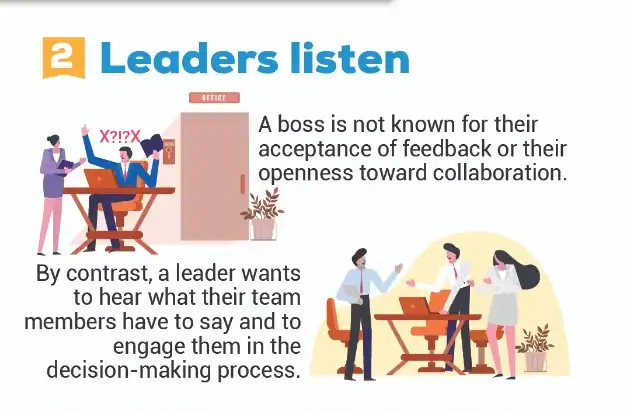
A boss may assume the person with the highest title should have the final word on everything. By contrast, a leader actively seeks information from the people closest to the work.
Listening does not mean giving up authority. Instead, it means making better decisions because you have better information. It also tells employees that their knowledge and experience matter. As a result, people become more willing to contribute ideas, identify problems, and take ownership.
3. Leaders Empower People Instead of Creating Dependence
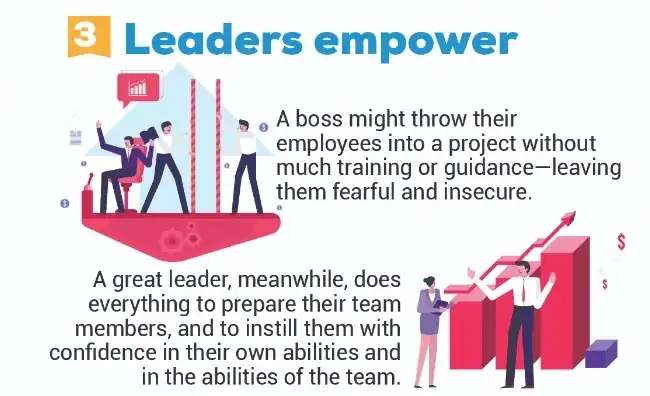
A boss can unintentionally create dependence by controlling every decision or throwing people into assignments without enough preparation. A leader takes a different approach. First, leaders provide expectations, resources, coaching, and context. Then, they give people appropriate room to perform.
That combination builds confidence and capability. Over time, the team becomes less dependent on the manager for every answer and more capable of solving problems independently.
4. Bosses Use Fear. Leaders Build Trust.
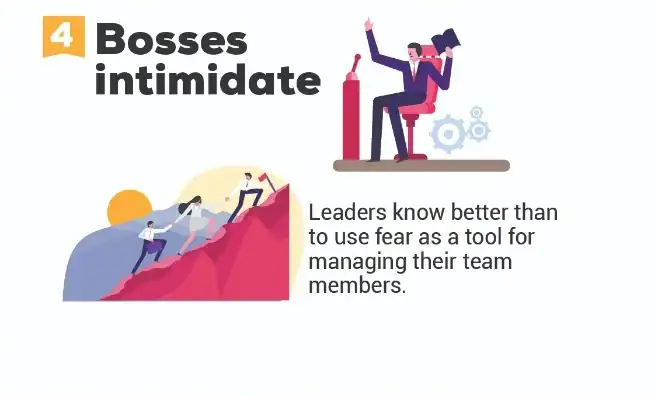
Fear can produce short term compliance. However, it rarely produces sustainable commitment. When employees are primarily focused on avoiding criticism or punishment, they become less likely to challenge bad assumptions, admit mistakes, or offer new ideas.
Effective leaders create trust while still maintaining standards. They address performance problems directly, but they do not weaponize authority. For a deeper look at this principle, read how new leaders build trust.
5. Bosses See Hierarchy. Leaders Build Relationships.
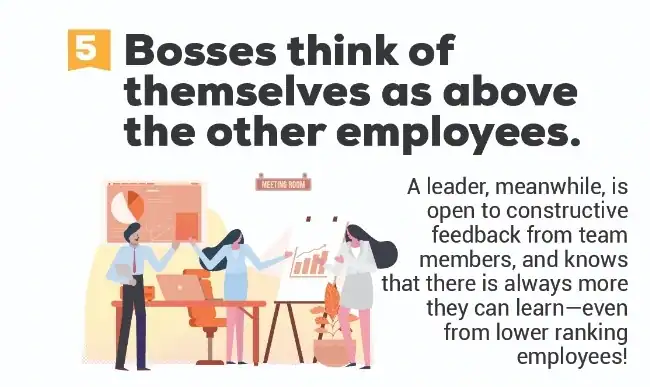
A boss may define the relationship primarily through rank. A leader understands that authority and influence are not the same thing. Therefore, strong leaders remain open to feedback, including feedback from people who report to them.
This does not eliminate hierarchy. Organizations still need clear accountability and decision rights. The difference is that leaders use hierarchy to create clarity rather than distance.
6. Bosses Criticize Publicly. Leaders Coach Privately.
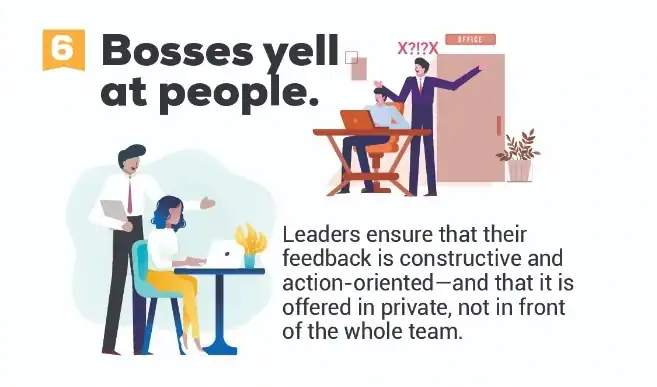
Public humiliation may get attention, but it usually damages trust and engagement. Strong leaders make feedback specific, constructive, and focused on what needs to improve.
Whenever possible, corrective feedback belongs in a private conversation. Meanwhile, recognition can often be given publicly. This approach protects dignity while keeping accountability strong.
7. Bosses Protect Control. Leaders Create Growth.

A boss often asks, “How do I stay in control?” A leader asks, “How do we improve and move forward?” That shift changes the conversation from preserving authority to producing results.
Leadership does not mean every decision becomes a committee vote. Rather, it means involving the right people, creating clarity about who owns the decision, and helping the team understand what happens next.
“The boss vs leader gap is not permanent. Leadership is a learnable set of behaviors. The impact of closing that gap can be much larger than most managers realize.”
Boss vs Leader at a Glance
A Boss Tends To
- Rely heavily on positional authority
- Direct more than listen
- Control decisions and information
- Use pressure to drive compliance
- View hierarchy as status
- Correct people in ways that can create defensiveness
- Focus on maintaining control
A Leader Tends To
- Lead through example and influence
- Listen before deciding
- Develop confidence and capability
- Build trust while maintaining accountability
- Use hierarchy to create clarity
- Coach people toward better performance
- Focus on growth and shared results
Management vs Leadership: Why Both Matter
The boss vs leader distinction becomes even clearer when you compare management and leadership. Management creates structure. It includes planning, organizing, staffing, budgeting, measuring performance, and maintaining operational control. Done well, management creates consistency.
Leadership focuses more heavily on influence, direction, culture, and commitment. Leaders help people understand where the organization is going, why the goal matters, and what each person owns. Therefore, the best executives do not choose between management and leadership. They develop the ability to do both.
The problem begins when organizations promote technically strong individual contributors into management roles without developing their leadership skills. Then, when team performance suffers, the organization may label it a people problem when the real issue is a leadership development gap.
Why the Leader vs Boss Difference Matters More Now
Today's workplace requires more judgment, adaptability, and collaboration. Teams may be distributed across locations, generations, functions, and time zones. In addition, AI and automation are changing how routine work gets completed.
As a result, the human side of leadership becomes more valuable, not less. This is where the leader vs boss difference becomes especially important. Employees still need clarity, feedback, accountability, trust, and a reason to care about the outcome. Command and control alone cannot provide those things.
For organizations trying to improve leadership culture, this is where the distinction between leadership vs boss behavior becomes practical. The question is not whether managers have authority. The question is whether they use that authority to increase the capability of the people around them.
3 Traits That Strengthen Modern Leadership
Clarity Over Control
In fast moving environments, leaders cannot personally control every detail. Instead, they need to make priorities, expectations, ownership, and decision rights clear. Once those elements are in place, capable employees can move faster with less unnecessary supervision.
For a structured approach to building this kind of accountability, explore The Solutions Oriented Leader workshop.
Emotional Intelligence Under Pressure
Leadership becomes most visible when something goes wrong. Effective leaders stay composed, ask better questions, and separate the problem from the person. Consequently, they can address performance without creating unnecessary fear or defensiveness.
Technology Without Losing the Human Connection
Strong leaders use AI, automation, and data to improve decisions and productivity. At the same time, they recognize that technology does not replace trust, communication, judgment, or human connection. Technology can amplify leadership. It cannot substitute for it.
The Question Every Manager Should Ask
Think about the last time a member of your team made a mistake. Did your response make that person more capable and confident for the next decision? Or did it simply make the person more cautious around you?
That answer tells you a great deal about where you currently sit on the boss vs leader spectrum. More importantly, it gives you something specific to improve.
“People follow leaders, not titles. The question is not whether you have authority. The question is what your leadership causes other people to become.”
People Follow Leaders, Not Titles
Whether you are a CEO, department head, business owner, or frontline manager, leadership is demonstrated through behavior. If you want a team that takes ownership, solves problems, and performs under pressure, start by modeling the same standards you expect from everyone else.
For more on strengthening team performance, read how to change your organizational culture. If you want individualized support in making the shift from manager to stronger leader, explore Dr. Rick Goodman's executive coaching services.
Boss vs Leader Frequently Asked Questions
What is the main difference between a boss and a leader?
Can a boss become a better leader?
Is being a boss always negative?
What is the difference between management and leadership?
How can I tell whether I am acting like a boss or a leader?
Why does the boss vs leader difference matter to company culture?
Ready to Make the Shift From Boss to Leader?
Dr. Rick Goodman helps executives and leadership teams build the behaviors that strengthen accountability, communication, culture, and performance through keynotes, workshops, leadership retreats, and executive coaching.
Check Availability