
Most people who end up in leadership roles got there because they were outstanding individual contributors. The best salesperson becomes the sales manager, the top engineer becomes the engineering director, and the strongest clinician becomes the department head. Organizations then wonder why they struggle. The skills that made someone great as an individual contributor have almost nothing to do with what makes someone an effective leader. Leadership is a skill set that has to be learned, practiced, and developed deliberately, just like every other skill set that matters.
This article covers the core leadership skills every leader needs to build, why they matter, and how to develop them in ways that produce lasting behavior change. For the character-based behaviors that determine how these skills get applied, see Leadership Qualities That Separate Good Leaders from Great Ones.
Why Leadership Skills Must Be Developed Deliberately
Leadership skills do not develop automatically with experience. A leader who has been communicating poorly for five years does not suddenly communicate well in year six. Without deliberate focus and honest feedback, experience reinforces existing patterns rather than improving them.
The Promotion Trap
Organizations promote people based on individual performance and then expect leadership to follow naturally. It rarely does. Moving from individual contributor to leader requires a fundamentally different skill set, and most organizations provide almost no structured support for making that transition well.
The result is predictable. New leaders rely on what worked for them as individuals, often becoming the bottleneck, the micromanager, or the person who cannot let go of the technical work they were promoted away from. Developing leadership skills deliberately, with the right frameworks and real feedback, is what breaks that pattern before it becomes entrenched.
"Nobody is born knowing how to lead a team through a crisis, deliver feedback that motivates rather than deflates, or make a high-stakes decision when the information is incomplete. These are skills. Every one of them is teachable."
The Five Core Leadership Skills Every Leader Needs
Skill 01Communication: The Leadership Skill That Drives Everything Else
Communication is the foundational leadership skill because every other skill expresses itself through it. A leader with exceptional strategic thinking who communicates poorly creates confusion instead of alignment, and one with genuine care for their team who cannot deliver difficult feedback clearly leaves problems unaddressed until they become crises.
Effective leadership communication is not about charisma or presentation skill. It is about clarity, consistency, and the ability to listen as effectively as speaking. Leaders who communicate well ensure their teams understand not just what to do but why it matters. That understanding converts compliance into commitment, which is the single biggest driver of team performance.
What Strong Leadership Communication Looks Like
Strong communicators deliver direction without ambiguity, give feedback that is specific enough to act on, adjust their style to match the person they are talking to, and listen in a way that makes people feel genuinely heard. The LAER framework, Listen, Acknowledge, Explore, Respond, is one of the most effective tools for building this skill in practice.
Skill 02Decision-Making Under Pressure: The Skill That Keeps Organizations Moving
After all, leaders are paid to decide. The ability to make sound decisions under conditions of uncertainty, incomplete information, and time pressure separates leaders who move organizations forward from those who create bottlenecks.
Decisiveness is not impulsiveness. It is the disciplined practice of gathering the right information, consulting the right people, setting a clear deadline for the decision, committing to a course of action, and moving forward without endless second-guessing. Leaders who model this behavior give their teams permission to do the same, which accelerates execution at every level of the organization.
Breaking the Analysis Paralysis Pattern
Many leaders who struggle with decision-making are not lacking intelligence. They are confusing thoroughness with delay. The goal is not a perfect decision. It is a good decision made in time to be useful. Building this skill requires practice making decisions at the threshold of sufficient information rather than waiting for certainty that rarely arrives.
Bring Dr. Rick Goodman to your next leadership event to build the skills that drive real organizational performance.
Check Dr. Rick's AvailabilityAccountability: The Leadership Skill That Defines Culture
Accountability starts at the top. Leaders who hold themselves visibly accountable, who own outcomes rather than assign blame, and who set clear expectations with clear consequences create cultures where accountability flows naturally at every level below them.
Why Avoiding Accountability Destroys Culture
Avoiding accountability teaches teams that standards are optional. The downstream effect on performance, trust, and retention is severe and often irreversible without significant leadership change. Applied consistently and with care, accountability becomes the single most powerful culture-building tool available to any leader.
The Two Components of Effective Accountability
Accountability requires both clarity and follow-through. Every person on the team needs to know exactly what they are responsible for, by when, and what success looks like. Follow-through means the leader actually checks in on commitments and addresses gaps when they appear. Both components are necessary. Without follow-through, clear expectations teach people that standards are merely suggestions.
Skill 04Coaching and Developing Others: The Skill That Multiplies Impact
Above all, the best leaders do not just manage work. They grow people. The ability to identify what someone needs to develop and then actively help them develop it is what separates managers from leaders in the truest sense.
Why Developing Others Multiplies Leadership Impact
Leaders who develop others build organizations that do not depend entirely on their own presence and effort to function. Every person they develop becomes a multiplier of the leader's impact. Over time, this skill is what determines whether a leader builds a legacy or a dependency.
What Coaching Others Actually Requires
Coaching others requires resisting the urge to solve every problem yourself. Rather than providing answers that short-circuit the other person's thinking, great coaches ask questions that develop it. Specific, honest feedback delivered in a way that motivates action rather than triggering defensiveness is the result. This is the skill most leaders most need and most consistently underinvest in.
Skill 05Adaptability: The Leadership Skill Built for the World We Are Actually In
Indeed, the pace of change in most industries has made adaptability one of the most consequential leadership skills available. Leaders who hold rigidly to strategies, processes, and mental models that no longer fit their environment do not just underperform. They actively slow down everyone around them.
Why Rigid Leaders Lose Ground in Fast Moving Markets
Adaptive leaders treat change as information rather than threat. They update their approach based on new evidence, lead their teams through ambiguity without losing alignment, and build organizations that respond to disruption rather than resist it. For a deeper look at adaptive leadership in practice, see the full guide on adaptive leadership vs traditional leadership.
How to Actually Develop Leadership Skills
Why Awareness Alone Is Not Enough
Reading about leadership skills builds awareness. However, applying them under real pressure is what builds capability. Most leadership development initiatives fail not because the content is wrong but because they stop at awareness without providing the structure for sustained application.
For example, knowing that you need to communicate more clearly does not make you a clearer communicator. Similarly, attending a workshop on accountability does not make you more accountable. Ultimately, what develops leadership skills is deliberate practice in real situations with honest feedback on what worked and what did not.
The Three Conditions for Fastest Development
Leaders who develop their skills fastest share three conditions. First, they seek honest feedback from people who will tell them the truth rather than managing up. Second, they apply new approaches in real situations rather than waiting until they feel ready. Third, and perhaps most importantly, they reflect on outcomes and adjust their approach based on what they learn, rather than repeating the same behavior and expecting different results.
As a result, working with a coach or attending a focused workshop accelerates this cycle significantly by providing the structured feedback and accountability that makes application stick.
The Mindset That Separates Fast Developers from Slow Ones
"Those who develop their leadership skills fastest are not the most naturally talented people in the room. What sets them apart is a commitment to applying what they learn under real conditions, with real stakes, in real time."

About Dr. Rick Goodman, CSP
Dr. Rick Goodman is a Certified Speaking Professional, six-time Global Gurus Top 30 Leadership Expert (2021 to 2026), and author of five books including the Amazon number one bestseller The Solutions Oriented Leader. He has delivered more than 2,000 programs across all 50 states and 32 countries, helping leaders at every level build the specific skills that drive measurable team and organizational performance.
His keynote programs, workshops, and executive coaching engagements are customized and immediately actionable.
Book Dr. Rick GoodmanContinue Building Your Leadership Foundation
- Leadership Qualities That Separate Good Leaders from Great Ones
- The Core Leadership Qualities That Drive Organizational Performance
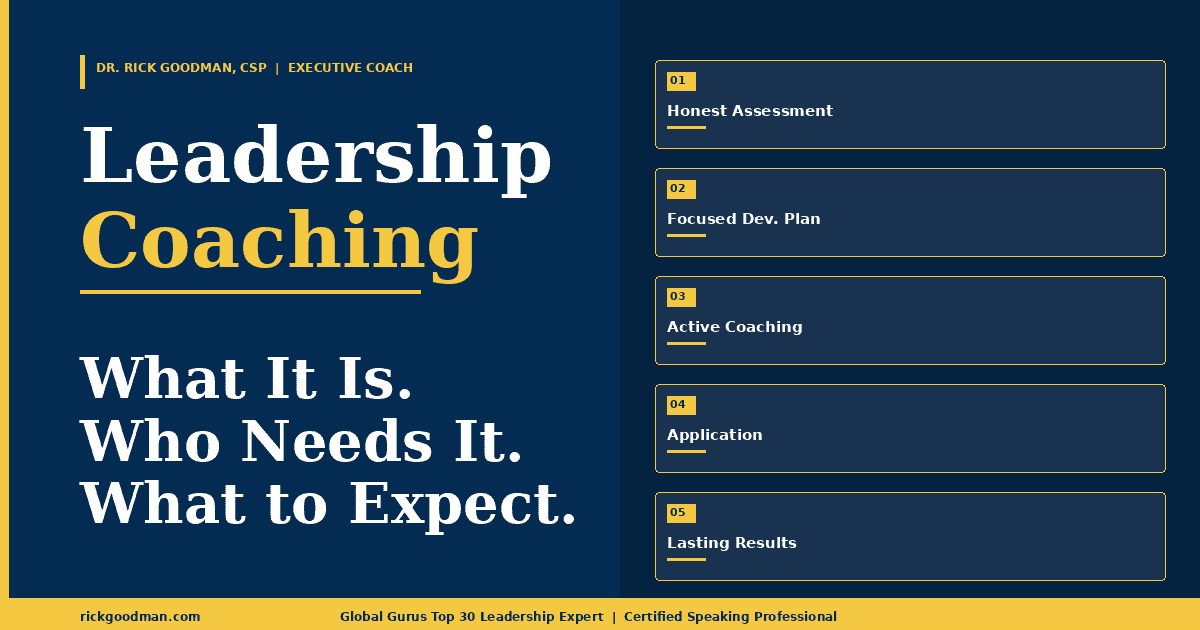
- Leadership Coaching: What It Is, Who Needs It, and What to Expect
- Adaptive Leadership vs Traditional Leadership
- Five Traits of a Solutions-Oriented Leader
- Solutions Oriented Leader Workshop
- Leadership Workshops and Corporate Training
Watch: Leadership Skills Every Leader Needs to Develop
Dr. Rick Goodman breaks down the core leadership skills that determine whether leaders build high-performance teams or environments of compliance, and exactly how to develop them.
Build the Leadership Skills That Drive Real Results
Dr. Rick Goodman delivers keynote programs, workshops, leadership retreats, and executive coaching that build the specific leadership skills your organization needs most. Every program is customized to your audience, your industry, and the real challenges your leaders are facing right now.
Recognized six consecutive years as a Global Gurus Top 30 Leadership Expert. Author of five books. Certified Speaking Professional.
Book Dr. Rick Goodman