
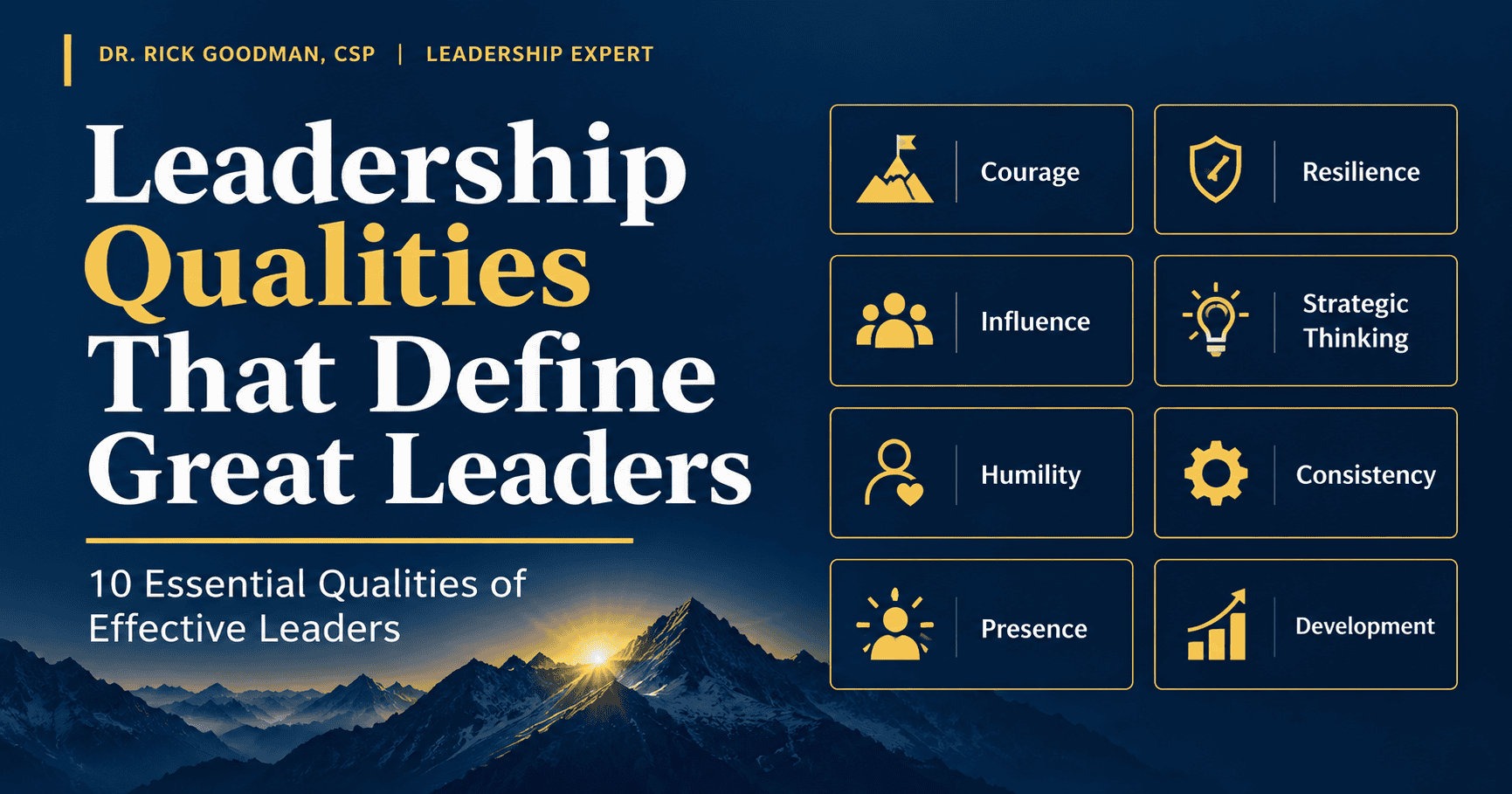
Effective Leadership Qualities: 10 Qualities of Great Leaders
Effective leadership qualities are not fixed personality traits. They are learnable behaviors that shape how leaders build trust, make decisions, respond under pressure, and develop the people around them. The strongest leaders do not simply know what good leadership looks like. They demonstrate it consistently when the stakes are real.
After more than 30 years coaching executives and delivering leadership programs across all 50 states and 32 countries, I have found that the qualities of a good leader become easiest to recognize in difficult moments. Pressure reveals whether integrity, courage, empathy, adaptability, and accountability are genuine habits or simply ideas a leader agrees with.
This page consolidates Dr. Rick Goodman's leadership qualities framework into one complete guide. For the specific competencies leaders practice, such as communication, coaching, and decision making, see Leadership Skills for Managers.
What Are Effective Leadership Qualities?
Effective leadership qualities are the character based behaviors and mindsets that determine how a leader uses authority, responds to pressure, and influences other people. They include qualities such as integrity, self awareness, courage, empathy, consistency, and adaptability.
Leadership qualities are different from leadership skills. Skills are tools. Qualities determine how and when those tools get used. A leader may understand how to communicate, for example, but still lack the courage to deliver an uncomfortable message. Likewise, a leader may understand delegation but lack the trust required to let another person own the work.
10 Leadership Qualities With Examples
Quality 01Integrity: Aligning Actions With Values
Integrity is the foundation of credible leadership. It means a leader's actions consistently match stated values, even when doing so is inconvenient. Employees notice very quickly when leaders ask others to follow standards they do not follow themselves.
Example: A leader discovers that a decision they defended was based on incomplete information. Instead of protecting their image, they acknowledge the mistake, explain what changed, and correct course.
Quality 02Self Awareness: Understanding Your Impact
Self awareness allows leaders to recognize their strengths, blind spots, emotional triggers, and communication patterns. Without it, the same leadership problems tend to follow a person from team to team because the leader assumes the problem is always external.
Example: A leader realizes that moving too quickly in meetings causes quieter team members to stop contributing. They deliberately create more space for input before making a decision.
Quality 03Courage: Making the Hard Call
Courage turns leadership values into action. It means addressing the issue that would be easier to avoid, delivering honest feedback before a problem becomes a crisis, and making a necessary decision even when it may be unpopular.
Example: A leader addresses a high performer's damaging behavior instead of ignoring it because the employee produces strong numbers.
Bring Dr. Rick Goodman to your next conference, leadership retreat, or executive program to turn these leadership qualities into practical behavior.
Check Dr. Rick's AvailabilityEmpathy: Understanding People Without Lowering Standards
Empathy is the ability to understand what another person is experiencing and use that understanding to lead more effectively. It does not mean avoiding accountability. In strong leaders, empathy and standards work together.
Example: Before responding to a missed deadline, a leader asks enough questions to understand what happened, then addresses both the underlying issue and the performance expectation.
Quality 05Decisiveness: Moving Forward With Enough Information
Leaders are paid to decide. Decisiveness is not impulsiveness. It is the discipline to gather the right input, set a reasonable decision point, choose a direction, and move forward without waiting for certainty that may never arrive.
Example: A leader sets a deadline for a decision, gathers input from the people closest to the issue, chooses the best available option, and establishes a review point to adjust if new information appears.
Quality 06Adaptability: Changing the Approach Without Losing Direction
Adaptability helps leaders respond when assumptions, markets, technology, or circumstances change. Adaptive leaders treat new information as a reason to learn rather than as a threat to the original plan.
Example: When a strategy stops producing the expected result, the leader changes the method while keeping the mission and priorities clear.
For the broader framework, see Adaptive Leadership: Turning Disruption Into Competitive Advantage.
Quality 07Strategic Thinking: Connecting Today's Decisions to Tomorrow's Direction
Strategic thinking requires leaders to look beyond immediate execution. Great leaders scan for change, challenge assumptions, and make resource decisions based on where the organization is going rather than only where it has been.
Example: Instead of asking only how to hit this quarter's target, a leader asks whether the current approach is building the capabilities the organization will need next year.
Quality 08Consistency: Building Trust Through Predictable Standards
Consistency is one of the most overlooked leadership qualities. Teams watch whether standards change with mood, pressure, politics, or the person involved. Predictable leadership behavior creates confidence because people know what to expect.
Example: A leader applies the same accountability standard to a top performer that they would apply to everyone else.
For a deeper look, read Consistent Leadership: Why Leadership Consistency Builds Trust.
"Leadership qualities become credible when people can predict that your values will still guide your behavior when the pressure is real."Quality 09
Communication: Creating Clarity and Alignment
Strong leadership communication is clear, timely, specific, and two way. Leaders must be able to explain what matters, why it matters, what has changed, and what people need to do next. They also need to listen well enough to understand what the team sees that they may be missing.
Example: During a major change, a leader clearly separates what is known, what is still uncertain, and what employees should focus on now.
Quality 10Developing Others: Multiplying Leadership Capacity
Good leaders produce results. Great leaders also develop people who can produce results without depending on the leader's constant involvement. Developing others means coaching, delegating meaningful responsibility, giving honest feedback, and creating opportunities for people to stretch.
Example: Rather than solving a difficult problem for a rising leader, the executive asks questions, gives clear decision boundaries, and lets that person own the solution.
How the Best Leadership Qualities Work Together
These qualities are not independent checkboxes. Courage without empathy can become harshness. Empathy without accountability can become avoidance. Decisiveness without self awareness can become overconfidence. Strategic thinking without communication creates direction that nobody can follow.
The strongest leaders develop these qualities as a connected system. When integrity, consistency, empathy, courage, and adaptability reinforce one another, leadership becomes more credible and more useful to the organization.
How to Develop Leadership Qualities
- Choose the quality with the highest leverage. Do not try to improve everything at once.
- Define the behavior behind the quality. "Be more empathetic" is vague. "Ask two questions before giving advice" is actionable.
- Practice under real conditions. Leadership development becomes meaningful when the stakes are real.
- Get honest feedback. Ask people who experience your leadership what they see.
- Review your results. Identify what changed, what did not, and what behavior needs another adjustment.
Leadership Qualities vs Leadership Skills
Leadership qualities describe how a leader shows up. Leadership skills describe what a leader can do. Integrity, courage, empathy, and consistency are qualities. Communication, coaching, delegation, conflict resolution, and decision making are skills.
Both matter. The best skill applied with poor judgment can still damage trust. The strongest character without enough practical skill can still produce weak execution. For the competency side of leadership, continue with Leadership Skills for Managers: 5 Skills Every Leader Needs.
Leadership Qualities and Trust
Trust is one of the clearest outcomes of strong leadership qualities. Integrity makes a leader believable. Consistency makes behavior predictable. Courage makes honesty possible. Empathy shows employees that the leader understands the human impact of decisions.
For the specific behaviors that strengthen credibility with a team, see How Leaders Build Trust: 7 Behaviors That Earn Team Confidence.

About Dr. Rick Goodman, CSP
Dr. Rick Goodman is a Certified Speaking Professional and Global Gurus Top 30 Leadership Expert who has delivered more than 2,000 programs across all 50 states and 32 countries. He is the author of five books, including the Amazon number one bestseller The Solutions Oriented Leader.
His keynote programs, workshops, leadership retreats, and executive coaching engagements help organizations turn leadership concepts into practical behaviors that improve trust, accountability, adaptability, and performance.
Book Dr. Rick GoodmanContinue Building Your Leadership Foundation
- Leadership Skills for Managers
- How Leaders Build Trust
- Consistent Leadership
- Organizational Resilience
- Adaptive Leadership
- Solutions Oriented Leader Workshop
- Executive Coaching Services
Watch: Leadership Qualities That Actually Drive Results
Dr. Rick Goodman breaks down leadership behaviors that influence ownership, communication, trust, and performance.
Develop the Leadership Qualities That Drive Real Results
Dr. Rick Goodman works with executives, leadership teams, and organizations to develop the qualities and behaviors that strengthen culture and performance.
Book Dr. Rick Goodman