
AI Change Management: Why Your Rollout Has a Trust Problem
AI Change Management: Why Your Rollout Has a Trust Problem
AI change management stalls when workers are both excited and afraid. A 2026 national study shows why, and the answer is not better technology. It is trust in the leaders rolling it out.
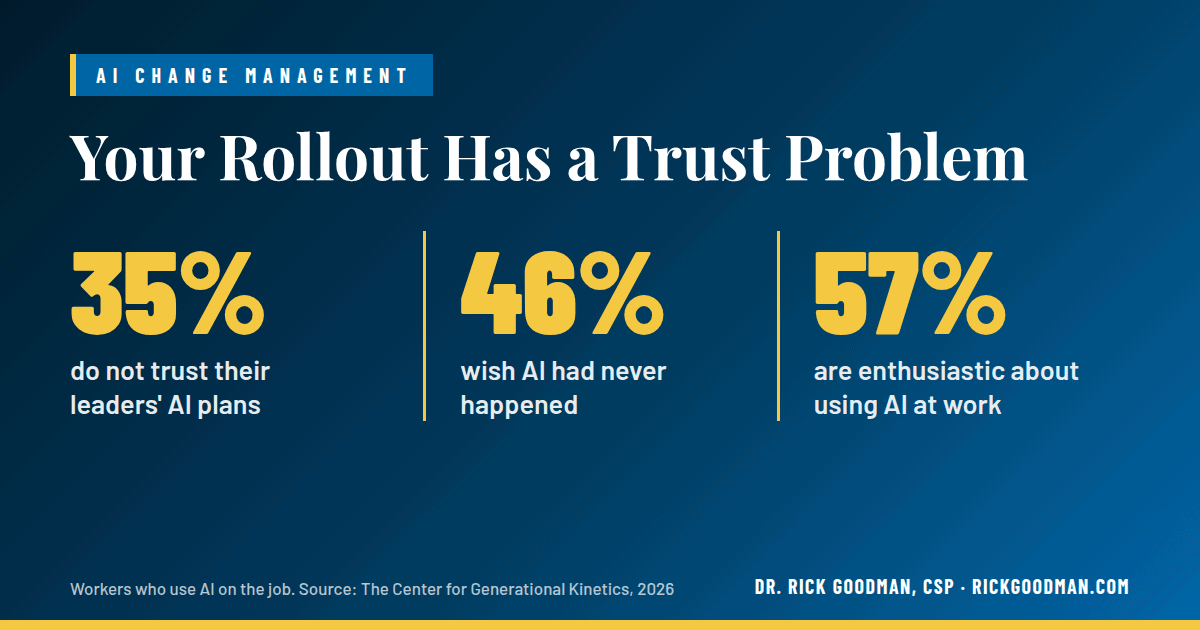
Nearly half of the American workers who use AI on the job wish it had never happened. Yet more than half of those same workers are enthusiastic about using it. Both statements are true, and together they explain why so many AI rollouts stall.
Why AI Change Management Fails When People Feel Excited and Afraid
According to a 2026 national study from The Center for Generational Kinetics (CGK), the research firm led by my friend Jason Dorsey, 46% of workers who have used AI at work in the past year wish AI had never happened. At the same time, 57% report an enthusiastic attitude toward using it in their jobs. In fact, your people are not divided into believers and skeptics. Most of them are both at the same time.
That tension is a leadership problem, not a technology problem. Leadership and AI are now inseparable, and effective AI change management starts with the data on where leaders are losing ground. As a result, the study points to an AI adoption trust gap that leaders can close.
The Trust Gap Is the Real Bottleneck in AI Change Management
The study found that 35% of workers who use AI do not trust their organization's leaders when it comes to AI plans. In other words, that is one in three people on every team. The weakest areas of trust were making AI a top priority for the organization (22%) and explaining how AI will affect performance reviews (21%).
Translate that into daily reality. Your people are not asking whether the tool works. Instead, they are asking what it means for their job, their pay and their standing. As a result, if leaders cannot answer those questions, no amount of training content will close the gap. Employee trust in AI starts with trust in the leaders rolling it out.
"Employees rarely resist AI because they misunderstand it. They hesitate because no one has told them what it means for their future."
Leaders and Employees Are Living in Different Realities
The distance between the executive suite and the front line is wider than most leaders assume. Enthusiasm for using AI in their jobs drops at every level of the organization:
- 80% of executives are enthusiastic.
- 68% of managers are enthusiastic.
- 46% of employees are enthusiastic.
For example, executives are twice as likely as employees to have lost sleep worrying about how AI might affect them (52% versus 26%), and 59% of executives would be comfortable with a virtual AI boss, compared with 33% of employees. Meanwhile, 42% of workers believe the people they work with are actively or passively opposed to AI. When leaders read their own enthusiasm as the organization's enthusiasm, they move too fast, communicate too little and mistake silence for agreement. Perceived resistance spreads whether or not it is accurate.
What Builds Trust in AI Change Management
Fortunately, the fixes are behavioral, and most cost little or nothing. In the study, workers ranked these as the five most effective ways for leaders to build trust in how AI is implemented:
- 37% Name the boundaries. Be transparent about where AI will not be used and which decisions stay with humans.
- 34% Share the plan. Clearly communicate the strategy, including details, timelines and plans.
- 32% Show job stability. Explain how using AI will make their jobs more stable.
- 32% Ask first. Involve employees in feedback on AI tools before wide rollout.
- 32% Teach the why. Help employees understand how AI works and the role it can play in their jobs.
What Did Not Work: The Executive Show and Gamification
Showing how executives personally use AI ranked near the bottom of ten trust building actions at 20%. In fact, the workforce is far more interested in how AI will affect them than in how their leaders use it.
Likewise, gamifying AI adoption with challenges, milestones or recognition ranked last of twelve skill building actions at 18%. Instead, people want learning, permission to fail and clarity about their own future.
Is your AI rollout building trust or quietly eroding it?
Leading AI Change Starts With People
When it comes to sustaining AI use and AI employee engagement after launch, workers rated people centered approaches highest:
- 73% said inviting employees who are succeeding with AI to share tips and playbooks, so they are seen as internal experts, would be effective.
- 70% said having a coach or go to person to troubleshoot AI problems would be effective.
- 70% said small groups learning AI tools together, specific to their roles, would be effective.
- 69% said making it safe to experiment and fail would be effective.
In short, the strongest adoption drivers in the study are human ones: peer champions, coaches, small learning groups and the safety to fail. For more on how adaptive leaders handle this shift, read adaptive leadership and the AI workforce.
Three AI Change Management Moves to Make This Week
You do not need a perfect AI strategy to start building trust. What you need is consistent leadership behavior.
Name the Boundaries
Tell your team where AI will not be used and which decisions stay with people. Then put it in writing and repeat it.
Close the Executive Gap
Ask your managers and employees, not just your leadership team, how they feel about AI and what they need. Then compare their answers with your own assumptions.
Remove One Hated Task
Two thirds of workers (66%) say eliminating a five minute task they hate with AI would increase their use of it. Start there, and let the early winners teach their peers.
AI change management is the work of leading a wave of organizational change, and change has always run on trust. Ultimately, the leaders who win this moment will be the ones who communicate clearly, involve their people early and make it safe to learn out loud. For the leadership framework that makes this systematic, explore the Solutions Oriented Leader workshop.
About the Research Behind This Article
This article draws on Leading the Human Side of AI Adoption in the Workforce, a 2026 national study from The Center for Generational Kinetics. My friend Jason Dorsey, President of CGK and a respected generational researcher, and his team gathered data that every leader navigating AI should read. I am grateful for their work, and the leadership perspective in this article is my own.
- The Center for Generational Kinetics, Leading the Human Side of AI Adoption in the Workforce, 2026. National survey of 1,000 employed Americans who used AI at work in the prior 12 months, margin of error plus or minus 3.1%. GenHQ.com
- Jason Dorsey, President, The Center for Generational Kinetics. JasonDorsey.com

About Dr. Rick Goodman, CSP
Dr. Rick Goodman is a Certified Speaking Professional, six time Global Gurus Top 30 Leadership Expert, and author of five books including the Amazon number one bestseller The Solutions Oriented Leader. He has delivered more than 2,000 programs across all 50 states and 32 countries, helping executives build the decision making habits and communication disciplines that create high trust organizations.
Continue Reading
- Adaptive Leadership AI Workforce: Are Your Leaders Ready?
- Belonging as an Adaptive Advantage: Why Culture Determines Whether Change Sticks
- Leading Through Uncertainty Without Losing Alignment
- Leadership Adaptability: Why It Matters and 5 Signs Your Team Is Falling Behind
- Take the Leadership Adaptability Scorecard
- Executive Coaching Services
Ready to Lead AI Change Management With Trust?
If your leadership team is navigating an AI rollout, Dr. Rick Goodman can help you align executives, equip managers and build trust with the front line through keynotes, leadership retreats and leadership training.
Book Dr. Rick GoodmanAI Change Management: Questions Leaders Ask Most
Common Questions About AI Adoption and Leadership Trust
If your question is not answered below, call us at 1-954-218-5325 or email rick@rickgoodman.com.
AI change management is the work of preparing, equipping and supporting people to adopt AI tools and new ways of working. The 2026 CGK study shows it is mostly a leadership and trust challenge: 35% of workers who use AI do not trust their leaders' AI plans, and 42% believe the people they work with are opposed to AI.
The AI adoption trust gap is the distance between how much leaders expect employees to embrace AI and how much employees actually trust their leaders' AI plans. In the 2026 CGK study, 35% of workers who use AI on the job said they do not trust their organization's leaders when it comes to AI plans.
Adoption depends on people, and people are carrying mixed emotions. The study found 46% of workers who use AI wish it had never happened, while 57% are enthusiastic about using it. In addition, 42% believe the people they work with are actively or passively opposed to AI, so a technically sound rollout can still lose momentum.
Leading the Rollout
Workers ranked transparency first. Being clear about where AI will not be used and which decisions stay with humans was the top trust builder at 37%, followed by clearly communicating the strategy, timelines and plans at 34%. All five of the top trust builders in the study are no cost or low cost.
No. Executives reported 80% enthusiasm for using AI in their jobs, compared with 68% of managers and 46% of employees. Executives were also far more likely to have lost sleep over AI (52%) than employees (26%), which shows how differently each level experiences the same rollout.
Much less than most leaders assume. Showing how executives personally use and learn AI was the lowest rated trust building action in the study at 20%. Employees care more about how AI will affect them than about how their executives use it.
Take their concerns seriously. In the study, 60% of workers ages 18 to 22 wish AI had never happened, and 58% say they are against using AI at work. Job security and environmental impact are leading concerns for this group, so leaders should address both directly rather than assuming younger workers are natural AI champions.
The research comes from The Center for Generational Kinetics (CGK), led by President Jason Dorsey, CEO Dr. Denise Villa and lead researcher Jared Boucher. The 2026 study surveyed 1,000 employed Americans who had used AI tools as part of their job in the prior 12 months, weighted to the 2020 U.S. Census, with a margin of error of plus or minus 3.1%.
Dr. Rick Goodman works with organizations through keynote speaking, leadership retreats, leadership training and executive coaching built on The Solutions Oriented Leader. Programs focus on aligning executives, equipping managers to communicate AI changes, supporting human resources and AI initiatives, and building the trust that drives adoption.