
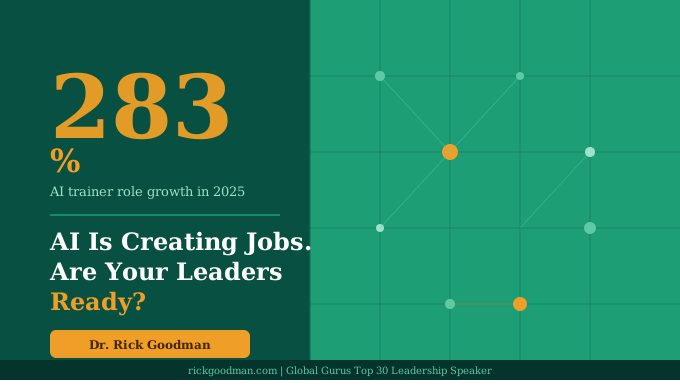
AI Is Creating Jobs. Are Your Leaders Ready?
The single most important adaptive leadership challenge facing organizations in today's AI workforce is not the one most leaders are focused on. AI trainer roles grew 283 percent in 2025, making them the fastest growing cross border job category on the planet.
Legal case managers grew 164 percent, while medical administrative assistants grew 123 percent. These numbers fundamentally change how leaders should think about artificial intelligence, workforce transformation, and leadership development.
AI is not shrinking your workforce. Instead, it is reshaping it at a pace that many leadership teams are not equipped to handle. Organizations that build adaptive leadership capacity now will define the competitive landscape for the next decade.
This article is part of the Adaptive Leadership series. For the full model and the other tools, start with the complete guide to adaptive leadership.
Adaptive Leadership in an AI Workforce Starts With Asking the Right Question
Every executive I speak with is asking the same question about AI: what is it going to replace? However, that is the wrong question entirely.
What the 2025 Hiring Data Actually Shows
The 2025 Deel Global Hiring Report tells a more nuanced story about the AI workforce than most headlines capture. The fastest growing roles require human judgment to oversee, evaluate, and improve AI systems.
These roles are not being automated away. Rather, they are being created because AI exists. Therefore, someone must lead the people filling them, and that responsibility lands squarely on today's leadership teams.
The right question is this: are my leaders adaptive enough to bring their teams through a workforce transformation that is moving faster than any training manual can keep up with?
"The organizations winning right now are not the ones with the best AI tools. They are the ones with the most adaptive leadership running those tools." — Dr. Rick Goodman
The Adaptability Zone: Building Adaptive Leadership for the AI Workforce
Uncertainty is no longer a phase your organization passes through on the way to stability. It is the permanent operating environment.
Moreover, the speed of AI workforce transformation will not slow down. It will keep creating disruption, new roles, new demands, and greater pressure on leaders at every level.
In my keynote program, The Adaptability Zone, I help organizations make adaptive leadership actionable rather than theoretical. The leaders who thrive are not the ones with every answer. They build the mindset, culture, and systems required to find answers faster than their competition.
Why AI Tools Alone Do Not Create Adaptability
I have worked with organizations that had advanced technology platforms, comprehensive AI workforce systems, and significant infrastructure investments but still underperformed.
In each case, the reason was consistent. Their leaders had not developed the adaptive capacity to bring people through transformation. A tool does not replace a leader. The leader determines how to deploy the tool and develop the people around it.
For broader context on how organizations are approaching AI workforce readiness, McKinsey's research on workforce skill building at scale reinforces exactly why adaptive leadership sits at the center of every successful transformation effort.
Bring The Adaptability Zone to your next leadership event and build the adaptive capacity your organization needs to lead through AI workforce transformation.
Three Adaptive Leadership Strategies for Today's AI Workforce
Based on 30 years of working with organizations across all 50 states and more than 30 countries, three adaptive leadership behaviors consistently separate high performing organizations from those falling behind.
1. Reframe AI as a Resource, Not a Threat
Effective adaptive leaders stop treating AI as something to fear or simply manage. They treat it as a resource that requires sharper human judgment, not less of it.
However, this reframe requires intentional work. It happens when leaders model the mindset consistently and build it into the culture deliberately.
2. Develop Teams for Roles That Do Not Fully Exist Yet
That is the reality of today's AI workforce. Training that focuses only on current job descriptions leaves an organization behind the curve.
As a result, organizations that build adaptive learning cultures now will gain a significant talent advantage. The 283 percent growth in AI trainer roles shows how quickly entirely new job categories can emerge.
3. Make Uncertainty a Normal Operating Condition
Likewise, teams that expect change are less likely to become paralyzed by it. They learn to respond with energy, judgment, and speed.
The difference between a reactive organization and a solutions oriented one is a major performance differentiator. Adaptive leadership creates that distinction through deliberate behaviors, systems, and expectations.
The Adaptive Leadership Imperative for 2025 and Beyond
The AI workforce is creating new jobs faster than most organizations can train people for them. That is not a technology problem. It is an adaptive leadership problem. And adaptive leadership problems have adaptive leadership solutions.
Ultimately, the organizations that outperform over the next five years will not simply be the ones that moved fastest on AI adoption.
They will be the organizations that built the adaptive leadership infrastructure to sustain adoption, develop people through each transition, and maintain performance through disruption.
The data from 2025 is clear. The question is not whether your organization has AI. The real question is whether your leaders are prepared for the workforce AI is creating.
For the complete framework, explore the Solutions Oriented Leader program. To build adaptive leadership capability at the executive level, review executive coaching with Dr. Rick Goodman.
Source: Deel 2025 State of Global Hiring Report.
AI trainer role growth figures reflect cross border hiring data across active contracts on the Deel platform in 2025.

About Dr. Rick Goodman, CSP
Dr. Rick Goodman is a Certified Speaking Professional, six-time Global Gurus Top 30 Leadership Expert (2021 to 2026), and author of five books including the Amazon number one bestseller The Solutions Oriented Leader. He has delivered more than 2,000 programs across all 50 states and 32 countries, helping leaders build the adaptive capacity to lead through AI-driven workforce transformation.
His keynote program The Adaptability Zone is built specifically for organizations navigating uncertainty, disruption, and rapid change.
Continue Building Your Adaptive Leadership Framework
- Adaptive Leadership: Turning Disruption Into Advantage
- Adaptive Leadership vs Traditional Leadership
- Adaptive Leadership in Action: Real World Examples
- Building an Adaptive Leadership Culture
- Regulating the Heat: How Adaptive Leaders Manage Tension Without Burnout
- Solutions Oriented Leader Workshop
- Executive Coaching Services
Bring The Adaptability Zone to Your Organization
Dr. Rick Goodman helps leadership teams build the adaptive leadership capacity to lead through AI workforce disruption, change, and transformation. Available for keynotes, workshops, and executive leadership retreats worldwide.
Recognized six consecutive years as a Global Gurus Top 30 Leadership Expert. Author of five books. Certified Speaking Professional.