
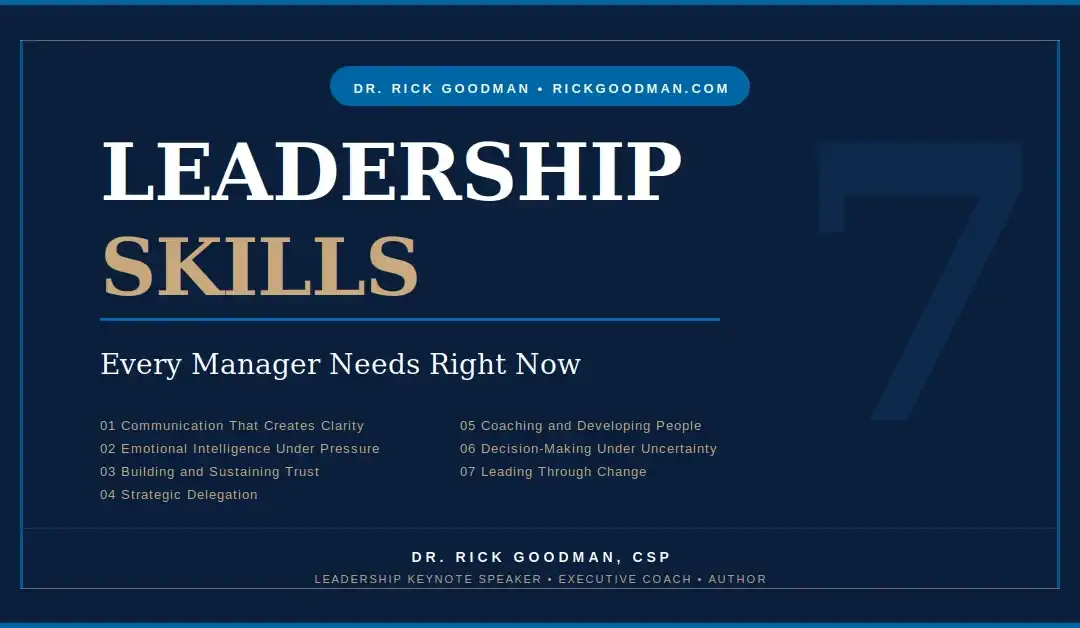
The leadership skills that drive results have always mattered. What has changed is which ones matter most — and how much the gap between managers who have them and managers who do not costs organizations in real, measurable terms.
After more than 30 years working with executives, managers, and leadership teams across all 50 states and 32 countries, I have seen the same pattern consistently. The managers who perform at the highest level are not always the most technically gifted or the most experienced. They are the ones who have developed a specific set of human skills that make everyone around them better.
Here is the breakdown of the leadership skills that matter most right now — and what developing them actually looks like in practice.
Why the Leadership Skills Conversation Has Changed
Ten years ago, the leadership skills conversation was largely about communication, delegation, and strategic thinking. Those still matter. But the environment has shifted dramatically in ways that have elevated a different set of capabilities to the top of the priority list.
Remote and hybrid work has made it impossible to manage through proximity and visibility. Multigenerational workforces have created teams with fundamentally different expectations of their managers. AI and automation have changed what human contribution at work actually means. And the pace of organizational change has accelerated to the point where the ability to lead through uncertainty is no longer a specialized skill — it is a baseline requirement.
The managers who are thriving in this environment are not the ones who doubled down on the old playbook. They are the ones who developed the skills the new environment demands.
The Core Leadership Skills That Drive Results Today
1. Communication That Creates Clarity
This is the foundational leadership skill — and most managers are significantly weaker at it than they realize. Communication at the leadership level is not about speaking clearly or writing well, though those matter. It is about creating shared understanding across diverse audiences, contexts, and communication styles. The best leaders communicate the same message differently to different people — not because they are inconsistent, but because they understand that clarity is defined by the receiver, not the sender. They explain the why behind decisions, not just the what. They listen actively and create the conditions where honest input actually flows upward. And they know how to communicate difficult truths in ways that motivate rather than demoralize.
2. Emotional Intelligence Under Pressure
Emotional intelligence — the ability to recognize, understand, and manage your own emotions while accurately reading and responding to the emotions of others — is consistently one of the strongest predictors of leadership effectiveness. It matters most under pressure, which is precisely when most managers revert to their least effective patterns. The leaders who maintain composure, empathy, and clear thinking when stakes are highest are the ones who retain team trust through difficult periods and emerge from challenges with their credibility intact. This is not a soft skill. It is a performance differentiator with measurable impact on team engagement, retention, and results.
3. The Ability to Build and Sustain Trust
Trust is the infrastructure of every high-performing team. Without it, communication becomes political, accountability becomes adversarial, and discretionary effort disappears. With it, teams move faster, collaborate more effectively, and navigate difficulty without fracturing. Building trust as a leader requires consistency between what you say and what you do, transparency about the reasoning behind decisions, genuine investment in the people on your team, and the willingness to be honest even when honesty is uncomfortable. Trust is built in small moments over time and destroyed in single moments of misalignment. The managers who understand this treat every interaction as a trust-building or trust-eroding choice.
4. Strategic Delegation and Ownership Distribution
One of the most common and most costly leadership failures I see across organizations of every size is the inability to delegate effectively. Managers who hold on to work they should be pushing to their teams create bottlenecks, stifle development, and limit their own capacity for higher-leverage activity. Effective delegation is not about offloading tasks. It is about transferring ownership — giving people the authority, resources, and accountability to own outcomes, not just complete assignments. This requires clarity about expectations, trust in people’s capabilities, and the discipline to let people learn from difficulty rather than rescuing them at the first sign of struggle. When done well, strategic delegation multiplies leadership capacity across the entire organization.
5. Coaching and Developing People
The shift from managing tasks to developing people is the single most important transition any manager can make — and one of the most underinvested leadership skills in most organizations. Managers who coach their teams produce compounding returns: people get better, teams get stronger, and the organization builds the leadership depth it needs to scale. Coaching at the management level means asking great questions instead of providing immediate answers, delivering feedback that is specific and behavioral rather than vague and personal, creating space for people to work through difficulty rather than removing all obstacles, and investing in people’s long-term development alongside their short-term performance. The managers who are most effective at this consistently produce the strongest team performance numbers — not despite spending time on development, but because of it.
6. Decision-Making Under Uncertainty
Every manager makes decisions. The differentiating skill is the ability to make good decisions quickly with incomplete information — which is the actual condition under which most consequential decisions get made. This requires a clear decision-making framework, the discipline to distinguish between decisions that are reversible and require speed versus decisions that are irreversible and require care, and the confidence to commit to a direction while remaining genuinely open to new information. It also requires the self-awareness to recognize your own decision-making patterns and biases — the tendencies that push you toward overconfidence, analysis paralysis, or defaulting to consensus when decisive leadership is what the situation actually demands.
7. Leading Through Change and Uncertainty
The ability to lead effectively through significant organizational change has moved from a specialized leadership skill to a baseline requirement. The organizations that are performing at the highest level are not the ones where change happens infrequently — they are the ones where leaders at every level have developed the capacity to maintain team alignment, decision quality, and psychological safety when the environment is most uncertain. This means communicating more, not less, during periods of ambiguity. It means being honest about what is known and what is not. It means maintaining clear priorities when everything feels urgent. And it means modeling the composure and adaptability you need your team to demonstrate.
How to Develop These Leadership Skills Deliberately
Leadership skills do not develop through awareness alone. Knowing what they are is the starting point, not the destination. The research is clear: the most effective leadership development happens through deliberate practice in real situations, structured feedback from people who will tell you the truth, and accountability systems that make progress visible over time.
The Center for Creative Leadership’s well-documented 70-20-10 model shows that approximately 70% of leadership development comes from challenging assignments and real-world experience, 20% from relationships and feedback, and only 10% from formal training. That does not mean training is not valuable — it means training without application and feedback produces minimal lasting change.
The most effective approaches to deliberate leadership skill development include executive coaching, structured leadership workshops, peer learning cohorts, and stretch assignments with real accountability for outcomes. The common thread is that they all combine new frameworks with real-world application and honest feedback — which is the combination that produces lasting behavioral change.
Where to Start Developing Your Leadership Skills
If you are serious about developing your leadership skills or building leadership capability across your organization, the most important first step is an honest assessment of where the gaps actually are — not where they are assumed to be.
The most common mistake I see is organizations investing in generic leadership training that addresses the skills everyone assumes matter without diagnosing the specific skills that are actually limiting performance in their context. The result is development activity that feels productive but produces minimal lasting change.
Whether you are looking for a leadership keynote that reframes how your team thinks about leadership, a leadership workshop that builds specific skills through real application, or executive coaching that develops individual leaders against their specific performance priorities, the starting point is always the same: an honest conversation about what is actually limiting performance and what development would produce the greatest return. Book that conversation here, or call 954-218-5325 to speak with Dr. Rick directly.