
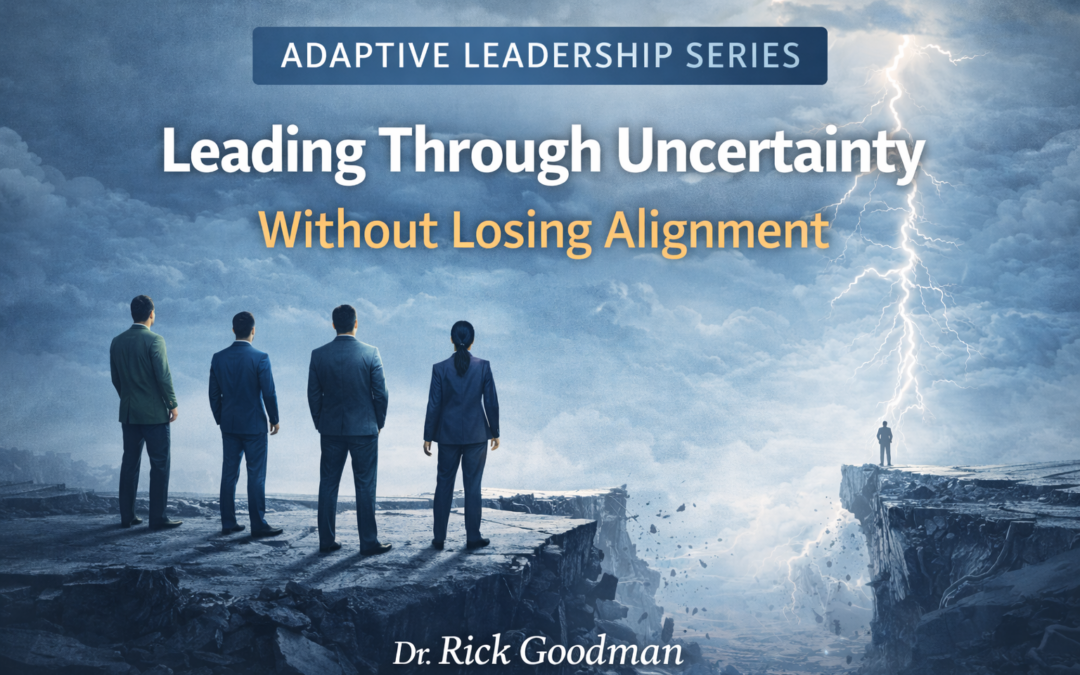
Leaders must lead through uncertainty to maintain alignment, decision speed, and trust when plans break and conditions change. Uncertainty exposes leadership gaps faster than any performance review, and most organizations were not built for this level of change.
This article is part of the Adaptive Leadership series. For foundational context, begin with Adaptive Leadership: Turning Disruption Into Advantage, then continue with Adaptive Leadership vs. Traditional Leadership: Why the Old Playbook Breaks Under Pressure.
How to Lead Through Uncertainty Without Losing Alignment
When conditions shift quickly, leaders face a false choice: tighten control to maintain alignment, or loosen control and risk chaos. Adaptive leadership rejects that tradeoff. The real challenge is not decentralizing decisions. It is maintaining alignment while doing it.
Why Leaders Fail to Lead Through Uncertainty
Most organizations lose alignment for three reasons:
- Priorities are not clear. Too many goals compete for attention, so execution slows.
- Decision rights are not defined. People hesitate, escalate, or duplicate work.
- Leaders confuse control with clarity. Centralization feels safe, but it creates bottlenecks.
When leaders try to hold things together by funneling decisions upward, they unintentionally reduce ownership and speed. Alignment does not come from proximity to the leader. It comes from shared understanding.
"Alignment does not come from proximity to the leader. It comes from shared understanding."
Three Guardrails That Keep Teams Aligned
1. Clear Non-Negotiables
Teams need to know what must not change: values, safety, customer impact, and key constraints such as legal, financial, and operational limits. Freedom works only inside boundaries.
2. Distributed Decision Rights
Alignment accelerates when people know who decides what. Define decision levels, whether that is the team, the leader, or the executive, along with required inputs and expected turnaround time. This removes hesitation and prevents what feels like constant approval ping-pong.
3. Relentless Communication of Intent
During change, tactics can evolve as long as intent stays constant. Leaders must repeat what the team is solving, why it matters, and what success looks like right now. This keeps teams moving in the same direction even when the path changes.
Bring Dr. Rick Goodman to your next leadership event to build the alignment practices your team needs before the next disruption hits.
The Leadership Behavior That Prevents Drift
The fastest way to lose alignment is silence. Adaptive leaders surface reality early, invite dissent without blame, and reinforce priorities repeatedly. Alignment is not a one-time announcement. It is a leadership practice.
Action Steps to Lead Through Uncertainty This Week
- Publish your top three priorities for the next 30 days in plain language.
- Define decision rights: what decisions teams can make without escalation.
- Run a 15-minute alignment huddle: what changed, what stays the same, and what is the next best move.

About Dr. Rick Goodman, CSP
Dr. Rick Goodman is a Certified Speaking Professional, six-time Global Gurus Top 30 Leadership Expert (2021 to 2026), and author of five books including the Amazon number one bestseller The Solutions Oriented Leader. He has delivered more than 2,000 programs across all 50 states and 32 countries, helping leadership teams maintain alignment and speed when conditions change fastest.
His keynote programs, workshops, and executive coaching engagements are customized and immediately actionable.
Continue Building Your Adaptive Leadership Framework
- Adaptive Leadership: Turning Disruption Into Advantage
- Adaptive Leadership vs Traditional Leadership
- Adaptive Leadership in Action: Real World Examples
- Regulating the Heat: How Adaptive Leaders Manage Tension Without Burnout
- Why Belonging Is the Foundation of an Adaptive Organization
- Solutions Oriented Leader Workshop
- Leadership Workshops
- Book Dr. Rick Goodman to Work With Your Leaders
Want a Clear Snapshot of How You Lead Under Pressure?
Dr. Rick Goodman delivers keynotes, workshops, and executive coaching that help leadership teams maintain alignment, define decision rights, and communicate intent clearly when conditions shift fastest.
Recognized six consecutive years as a Global Gurus Top 30 Leadership Expert. Author of five books. Certified Speaking Professional.
Leading Through Uncertainty: Questions Leaders and Organizations Ask Most
Common Questions About Maintaining Alignment During Change
If your question is not answered below, call us at 1-954-218-5325 or email rick@rickgoodman.com.
Leaders maintain alignment during uncertainty by publishing clear non-negotiables, defining decision rights so people know what they can decide without escalating, and repeating intent consistently even as tactics change. Alignment comes from shared understanding, not from funneling every decision through the leader.
Organizations lose alignment for three main reasons: priorities are not clear so too many goals compete for attention, decision rights are not defined so people hesitate or escalate unnecessarily, and leaders confuse control with clarity, centralizing decisions in a way that feels safe but creates bottlenecks.
Tightening control routes every decision through the leader, which feels safe but slows the organization down. Creating clarity means defining non-negotiables, decision rights, and intent clearly enough that teams can move quickly without waiting for approval. Clarity scales. Control does not.
Decision rights define which decisions a team can make on its own, which require a leader's input, and which require executive sign-off. Without clear decision rights, people hesitate, escalate unnecessarily, or duplicate work. Publishing decision rights removes that hesitation and prevents what feels like constant approval ping-pong.
Leaders should repeat intent constantly during change, far more often than feels necessary. Tactics can and should evolve as conditions shift, but intent needs to stay constant and visible. Leaders who only announce direction once lose alignment the moment the situation changes.
Silence is the fastest way to lose alignment. When leaders stop surfacing reality, avoid naming what has changed, or go quiet under pressure, teams fill the gap with assumptions. Adaptive leaders surface reality early, invite dissent without blame, and reinforce priorities repeatedly rather than treating alignment as a one-time announcement.
Dr. Rick Goodman delivers keynote programs, workshops, and executive coaching that give leadership teams practical frameworks for maintaining alignment, defining decision rights, and communicating intent clearly during periods of significant change. Programs are customized to the specific disruption each organization is facing. To start the conversation, visit the booking calendar or call 1-954-218-5325.