
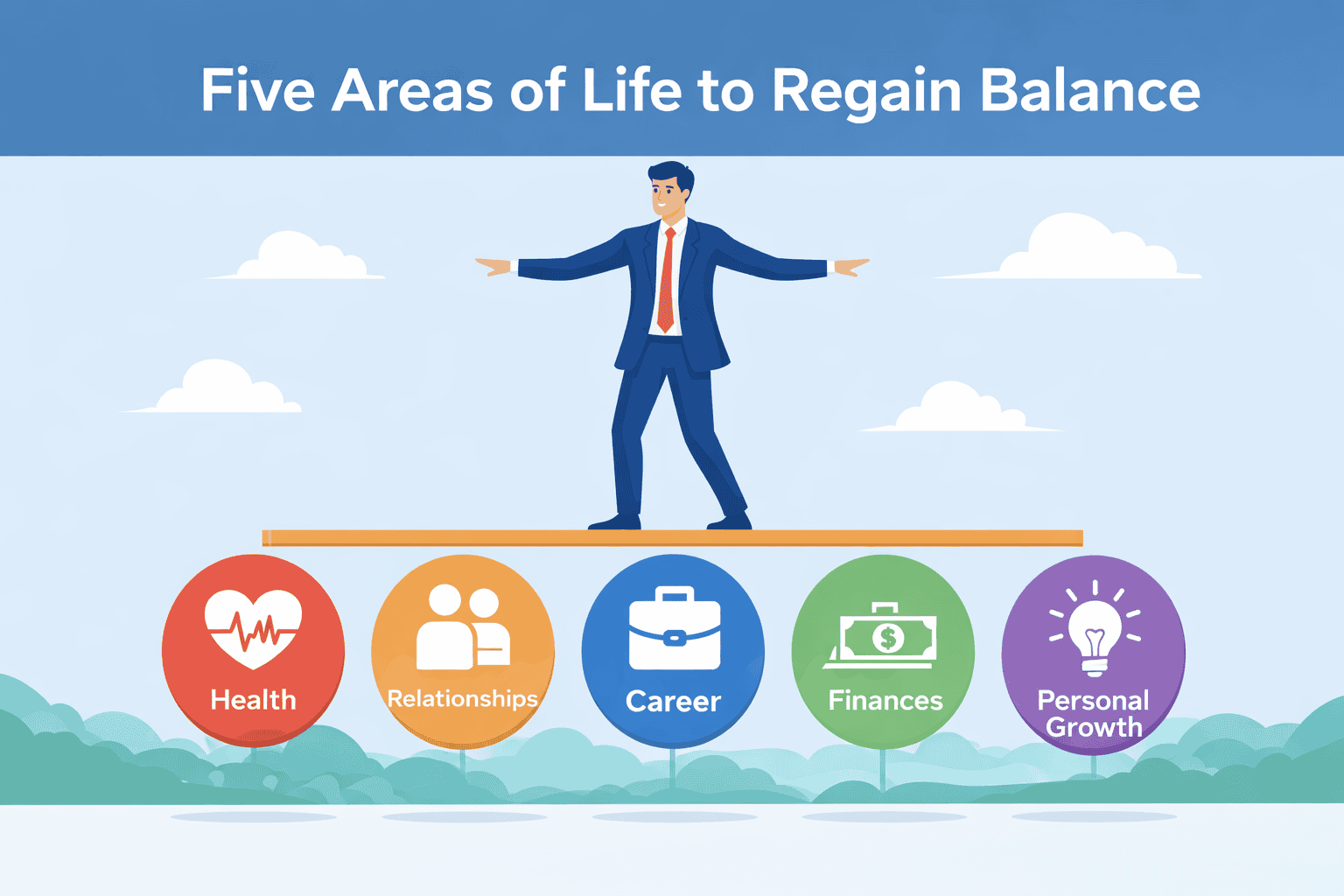
The five areas of life leaders focus on to regain balance are not a wellness concept. They are a performance strategy. When leaders neglect even one of these areas, stress compounds, decision quality drops, and the teams around them feel it first.
Leadership today demands more energy, focus, and emotional bandwidth than ever before. Between constant connectivity, growing responsibilities, and rising expectations, many leaders find themselves productive on paper but dangerously out of alignment in practice. After more than 30 years working with executives, Fortune 500 companies, healthcare systems, and championship sports teams, I have found that the leaders who sustain high performance over time are not the ones who grind the hardest. They are the ones who intentionally align five core areas of their lives.
Why the Five Areas of Life Leaders Focus On Are a Performance Strategy
Balance does not mean equal time across every area of your life. It means intentional alignment. Leaders who restore alignment across the five core areas experience greater focus, stronger communication, faster decision-making, and improved emotional intelligence under pressure.
In my leadership development work with organizations across every major industry, the pattern is consistent. Leaders who treat balance as a discipline, not an afterthought, outperform their peers and build stronger, more resilient teams. The five areas of life leaders focus on provide the framework for doing exactly that.
The Five Areas of Life Leaders Must Align
Each of these five areas plays a distinct role in sustaining leadership performance. Neglecting any one of them creates a ripple effect across the others.
1. Career and Financial
This is where most leaders over-invest. Career and financial goals drive ambition and provide the resources to pursue everything else. However, when this area dominates at the expense of the other four, leaders burn out faster, relationships suffer, and the performance gains they are chasing start to reverse.
The goal is not to work less. It is to ensure your career ambitions are anchored to a clear purpose and supported by the other four areas. Leaders who align career goals with personal values make better decisions, lead with more conviction, and sustain motivation far longer than those chasing metrics alone.
2. Developmental and Educational
The leaders who last are the ones who never stop learning. Developmental growth, through executive coaching, leadership training, reading, or mentorship, separates leaders who adapt from those who stagnate.
In a business environment that changes faster every year, ongoing development is not optional. It is a competitive requirement. Leaders who invest in their own growth model that behavior for their entire organization. Moreover, they create a culture of continuous improvement that compounds over time. This is one of the five areas of life leaders focus on that directly impacts organizational performance.
3. Physical Health
Your physical health is your leadership infrastructure. Without it, every other area suffers. Sleep deprivation impairs decision-making. Poor nutrition drains energy. A sedentary lifestyle accelerates cognitive decline and emotional volatility.
The highest performing leaders treat physical health the same way they treat their most important business metrics. They track it, protect it, and refuse to negotiate on it. That means consistent sleep, daily movement, and structured nutrition, not as self-indulgence but as performance requirements. For a deeper look at this connection, see the article on self-care and productivity for leaders.
Trying to build these habits across an entire leadership team, not just one executive at a time?
Check Rick's Availability4. Family, Relationships, and Social Connection
No leader performs sustainably in isolation. The quality of your relationships, at home, with friends, and in your professional network, directly impacts your emotional resilience, your perspective, and your ability to lead through adversity.
Leaders who neglect this area often do not notice the cost until it becomes a crisis. Strained personal relationships spill into professional performance. Isolation accelerates burnout. Building and protecting meaningful relationships is not a soft priority. It is one of the five areas of life leaders focus on that holds everything else together when pressure mounts.
5. Spiritual and Personal Values
This does not require a religious framework. What it does require is clarity about what you stand for, what you believe, and what gives your leadership meaning beyond the results on a scoreboard.
Leaders who are grounded in their values make faster decisions under pressure because the filter is already in place. They lead with greater consistency because their actions align with their convictions. Furthermore, they attract team members who share those values, which builds trust and cohesion faster than any team-building exercise ever could.
"The leaders who perform at the highest level over the longest period of time treat all five areas as a system, not a checklist. Strength in one area amplifies the others. Neglect in one area erodes the rest."
Setting Goals Across the Five Areas of Life
Most goal setting advice treats life as five separate categories with five separate lists. That approach breaks down under real pressure. Leaders who set goals successfully across these five areas of life treat them as one connected system, where a goal in one area is only worth pursuing if it holds up against the other four.
When you are setting goals in these five areas of life, start with career and financial targets, then stress test each one against physical health, relationships, development, and personal values. If a career goal requires sacrificing sleep, damaging a key relationship, or abandoning a core value, it is not a sustainable goal. It is a short term trade that creates a longer term cost. This is the difference between goal setting as a list making exercise and goal setting as a leadership discipline.
How the Five Areas of Life Leaders Focus On Work Together
These five areas are not independent. They are interdependent. When leaders intentionally revisit and realign these five areas, they are better equipped to sustain energy, make sound decisions under pressure, and model the behaviors that build high-performing cultures.
According to Thought Leaders Journal, leaders who invest in balance across these core areas consistently outperform those who do not, in both short term results and long term organizational health. That is what sustainable leadership performance looks like in practice.
For the organizational culture framework that supports this kind of leadership, see the article on organizational culture that attracts top talent. For the leadership system that makes these behaviors scalable across your team, explore the Solutions Oriented Leader workshop.
"The leaders who sustain high performance are not the ones who grind the hardest. They are the ones who protect their alignment across all five areas of life, consistently, intentionally, and without apology."
Build a Leadership Culture That Sustains Performance
If your organization develops leaders who need to perform under pressure without burning out, these five areas provide the foundation. The challenge for most organizations is not knowing what these areas are. It is building the systems and accountability that make alignment an ongoing discipline rather than a one time conversation.
That is exactly where bringing in a leadership keynote speaker creates immediate organizational impact, by giving your entire leadership team a shared framework and a shared language for this work at the same time.

About Dr. Rick Goodman: Dr. Rick Goodman, CSP, is a Certified Speaking Professional and a Global Gurus Top 30 Leadership Expert who has delivered more than 2,000 programs across all 50 states and 32 countries. He is the author of five books, including the Amazon number one bestseller The Solutions Oriented Leader, and works with organizations as a keynote speaker, executive coach, and consultant.
More About RickContinue Reading
Ready to Help Your Leaders Perform at Their Highest Level?
Dr. Rick Goodman works with organizations across the country to build the leadership alignment, performance habits, and organizational culture that sustain results over the long term. Keynotes, workshops, and executive coaching programs that produce measurable outcomes.
Book Dr. Rick Goodman