
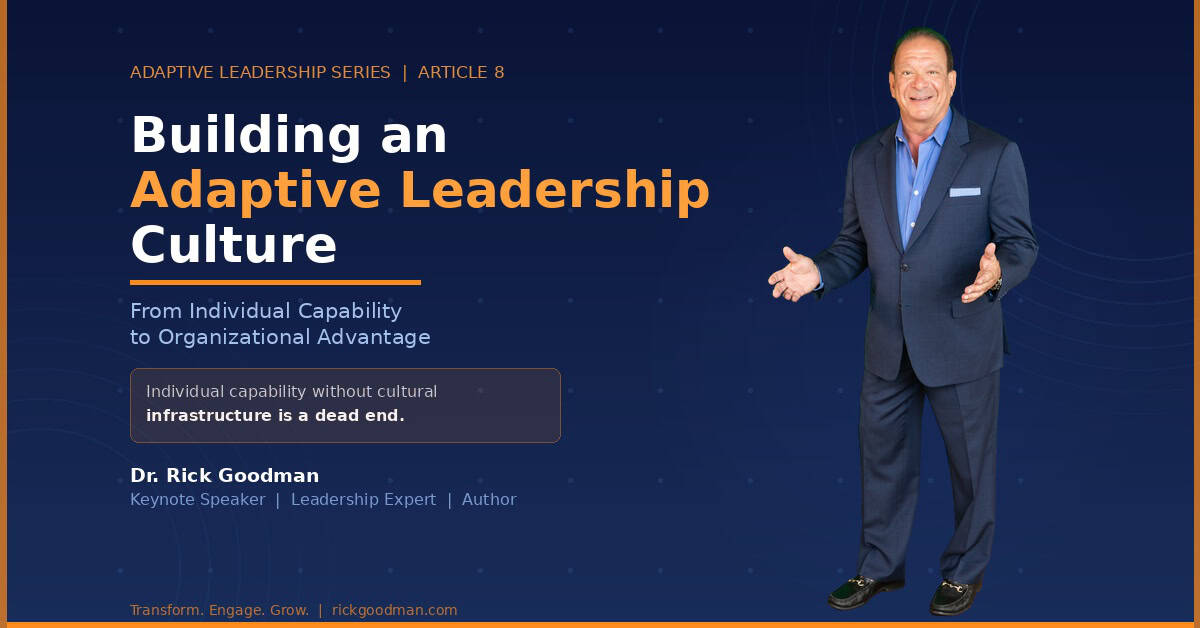
Building an adaptive leadership culture is one of the most overlooked investments an organization can make. Most companies invest in adaptive leadership the wrong way. They send a handful of high potentials to a workshop, bring in a speaker for an offsite, and hope the mindset spreads on its own. It does not.
Individual capability without cultural infrastructure is a dead end. A leader may return from training energized about adaptive thinking and immediately encounter a system that still rewards comfort, punishes uncertainty, and measures the wrong things.
Consequently, the new behavior often disappears within 90 days. The investment evaporates because the surrounding culture never changed.
Building a true adaptive leadership culture is different. It is about embedding adaptive thinking into the structures, systems, and rituals that govern how your organization actually operates every single day. When you do that, adaptive leadership stops being a personal skill and becomes an organizational advantage.
This is the final article in the Adaptive Leadership series. If you are starting here, go back to the Adaptive Leadership pillar page for the full framework and the other tools in the series.
Why Adaptive Leadership Culture Is the Multiplier
Culture, not strategy or talent alone, is the primary driver of sustained organizational performance. Research consistently shows that companies with strong, aligned cultures outperform their peers in revenue growth, employee engagement, and adaptability over time.
Here is what that means for adaptive leadership. You can have brilliant individual leaders. But if your culture punishes learning from failure, protects the status quo, or treats uncertainty as incompetence, those leaders will either conform or leave. Culture wins every time.
The goal is to flip that dynamic. Build an adaptive leadership culture where the environment makes adaptive behavior easier, more expected, and more rewarded than the alternative.
In addition, Thought Leaders Journal reports that organizations embedding adaptive capacity into their operating systems outperform those relying on individual leader development alone, particularly during rapid market change.
Four Systems That Either Build or Block an Adaptive Culture
1. Strategy and Planning Processes
Most strategic planning cycles are built for a stable world. Annual plans, quarterly reviews, fixed KPIs. That structure made sense when markets moved slowly. It does not anymore.
Adaptive organizations treat strategy as a living document, not a locked-in contract. Therefore, regular assumption checks become part of the planning process.
Leaders ask what has changed since a decision was made and whether that change requires a different response. As a result, strategic pivots become informed adjustments rather than leadership failures.
If your planning process punishes leaders who course-correct, you are selecting for rigidity. When you reward leaders who adapt based on new information, you are building adaptive capacity into the organization itself.
2. Meetings and Communication Rituals
Walk into your next leadership meeting and pay attention to who talks and who stays quiet. Pay attention to what gets rewarded when someone raises a problem versus what happens when someone brings a solution. Culture lives in those moments.
Adaptive cultures create deliberate space for difficult conversations. Solutions Oriented leaders distinguish between technical problems, which someone already knows how to solve, and adaptive challenges, which require new thinking.
Moreover, they make it safe to say "I do not know." They treat that honesty as a leadership strength rather than a liability.
One of the most powerful shifts I have seen organizations make is introducing a simple question into their leadership conversations: "What are we avoiding?" That one question changes the entire dynamic of a meeting. It surfaces the real work.
Bring Dr. Rick Goodman to your next leadership event to help your organization build the systems that make adaptive behavior the default, not the exception.
3. Performance Metrics and Recognition
You get what you measure. That is not a management cliche. It is a law of organizational behavior.
If your metrics only reward short-term results, your leaders will optimize for short-term results, even when long-term adaptation is what the situation actually demands. When your recognition systems only celebrate wins and ignore productive struggle, your people will avoid the kind of experimentation that drives innovation.
Adaptive cultures measure learning, not just outcomes. For example, they recognize the leader who ran a disciplined pilot, learned something important, and adjusted course.
At the same time, the best leaders track team engagement and psychological safety alongside revenue and productivity. That makes the invisible work of culture visible.
4. Talent and Development Systems
Who you hire, who you promote, and who you develop sends the loudest possible signal about what your culture actually values.
For example, I have worked with organizations that talk about adaptive leadership in their values and then consistently promote the most technically proficient people regardless of their ability to lead through uncertainty. As a result, the behavior contradicts the message. Ultimately, people watch what gets rewarded, not what gets said.
Building an adaptive leadership culture means identifying adaptive capability during hiring and developing it deliberately through leadership programs.
It also means making adaptability a visible criterion in promotion decisions. In addition, organizations need team experiences that build the trust and psychological safety adaptive work requires.
The Leadership Behaviors That Signal Culture Change
Culture shifts when senior leaders model the behaviors they are asking for. Not in speeches. In their daily actions. Here is what adaptive leadership behavior looks like at the top of an organization.
Naming uncertainty out loud. When senior leaders say "I do not have a clear answer yet, and here is how we are going to figure it out," they give everyone else permission to operate in ambiguity without panicking.
Separating diagnosis from solution. Adaptive leaders slow down before jumping to fixes. They ask whether this is a technical problem or an adaptive one before deciding how to respond. That discipline cascades down through the organization.
Protecting experimental space. The best adaptive cultures carve out room for pilots, prototypes, and informed experiments. They allocate time, budget, and political cover for the kind of learning that does not always show a clean ROI in 90 days.
Holding people to learning, not just results. This is the hardest one for most organizations. It requires leaders who can distinguish between a failure caused by poor judgment and a failure caused by genuine uncertainty in a complex situation. Adaptive cultures hold people accountable for both the quality of their thinking and the outcome of their actions.
"The organizations that will win over the next decade are not the ones with the best strategy. They are the ones that can learn and adapt faster than the rate of change in their environment."
How to Start Building Your Adaptive Leadership Culture Right Now
You do not overhaul a culture in a quarter. But you can start shifting it this week. Here is a practical sequence I use with executive coaching clients.
Audit your current signals. Look at your last five promotions, your last five major strategy decisions, your last five leadership meetings. What do those moments say about what your culture actually values? Where does adaptive capability show up, and where is it absent?
Identify one structural change. Pick one system, a meeting format, a planning ritual, a performance metric, and redesign it to reinforce adaptive behavior. One real structural change has more impact than ten training sessions.
Create a language shift. Start introducing the vocabulary of adaptive leadership into your leadership conversations. The distinction between technical and adaptive work. The question "What are we avoiding?" The recognition of real losses in any significant change. Language shapes perception. Perception shapes behavior.
Build psychological safety deliberately. Adaptive work requires people to surface uncomfortable truths and challenge existing assumptions. However, that only happens when people feel safe enough to speak honestly.
If your current culture lacks that safety, build it before asking people to do adaptive work. The Solutions Oriented Leader workshop is one place to start.
Measure what matters. Add at least one adaptive indicator to your leadership scorecard. Team learning velocity, the quality of failure debriefs, employee willingness to raise problems early. Whatever you measure signals what you value.
The Competitive Advantage You Are Leaving on the Table
The disruption you are managing today is not the last disruption. The organizations that will win over the next decade are not the ones with the best strategy. They are the ones that can learn and adapt faster than the rate of change in their environment.
That is not a capability you can buy. It is not something a single leader can create alone. It is a cultural advantage that gets built over time, through consistent investment in the systems, behaviors, and structures that make adaptive thinking the norm rather than the exception.
Organizations that have done this work do not simply survive disruption. Instead, they use it. Change gets spotted sooner, and mobilization happens faster.
Furthermore, every cycle produces learning that carries forward. The result is institutional resilience that turns competitive threats into competitive opportunities.
That is what an adaptive leadership culture actually delivers. Not just better leaders. An organization that is structurally better at change than the competition.

About Dr. Rick Goodman, CSP
Dr. Rick Goodman is a Certified Speaking Professional, six-time Global Gurus Top 30 Leadership Expert (2021 to 2026), and author of five books including the Amazon number one bestseller The Solutions Oriented Leader. He has delivered more than 2,000 programs across all 50 states and 32 countries, helping organizations embed adaptive leadership into the systems that sustain it long after the keynote ends.
His keynote programs, leadership retreats, and executive coaching engagements are customized and immediately actionable.
Continue Building Your Adaptive Leadership Framework
- Adaptive Leadership: Turning Disruption Into Advantage
- Adaptive Leadership vs Traditional Leadership
- Adaptive Leadership in Action: Real World Examples
- Regulating the Heat: How Adaptive Leaders Manage Tension Without Burnout
- Why Belonging Is the Foundation of an Adaptive Organization
- Solutions Oriented Leader Workshop
- Executive Coaching Services
Build an Organization That Is Structurally Better at Change
Dr. Rick Goodman is a Certified Speaking Professional ranked among the Top 30 Global Leadership Gurus. His keynote programs, leadership retreats, and executive coaching engagements help organizations embed adaptive leadership into the systems, behaviors, and culture that drive lasting competitive advantage.