
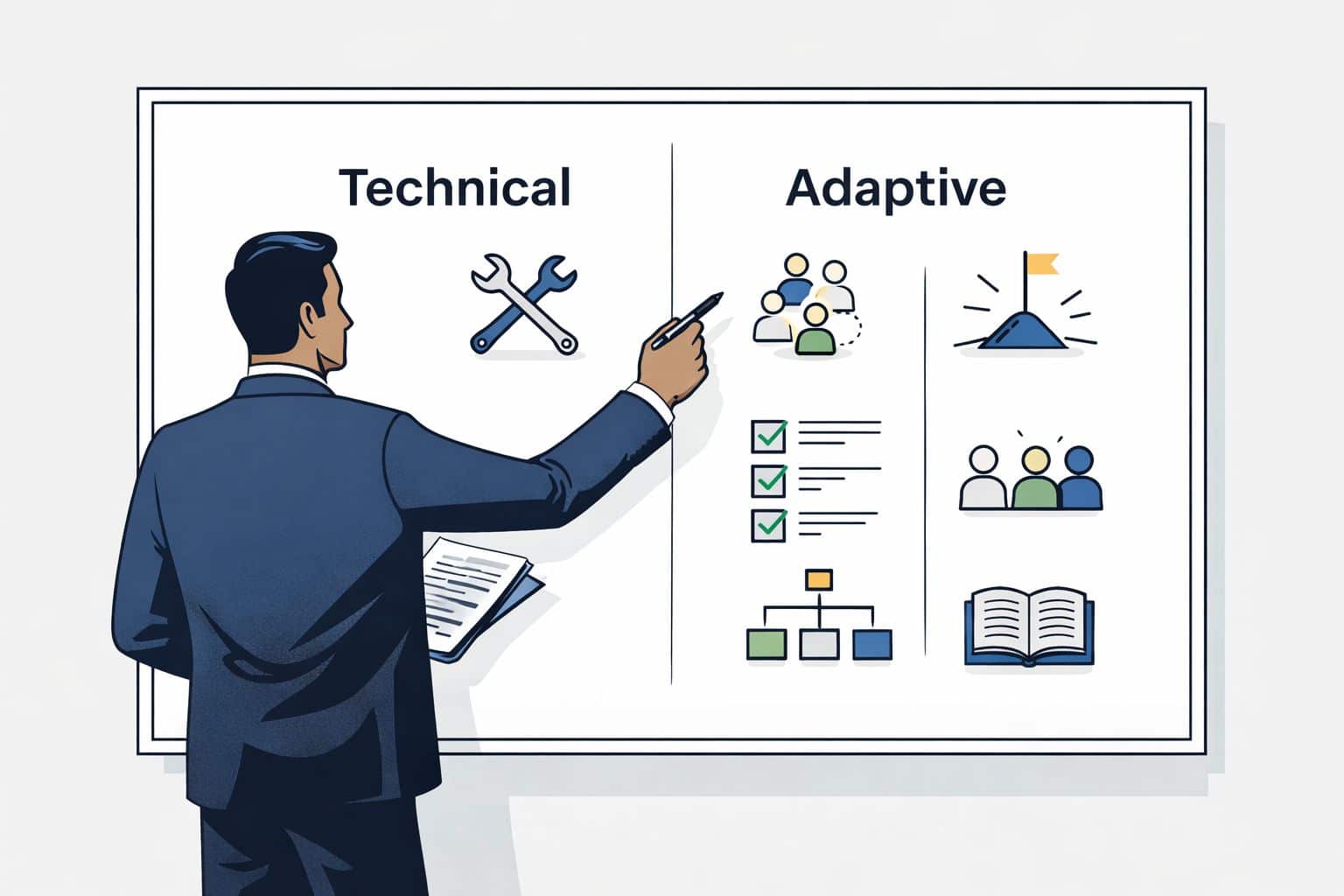
Technical Problems vs Adaptive Challenges: The Distinction Every Leader Must Master
Adaptive leadership challenges are the reason so many change efforts stall, because leaders treat them like technical problems instead of learning and behavior shifts.
If you want the full context for this approach, start with the complete guide to adaptive leadership. It will help you diagnose the challenge before you choose your strategy.
When you diagnose correctly, you pick the right move, the right timeline, and the right messaging. However, when you misdiagnose, you create busywork, frustration, and resistance that looks like a people issue but is actually a leadership issue.
Adaptive Leadership Challenges Versus Technical Problems
Technical problems can be solved by applying knowledge. In contrast, adaptive challenges must be solved by learning. Therefore, the work requires different leadership moves.
What a Technical Problem Looks Like
A technical problem has a known or knowable solution. Someone has done it before, or it can be figured out with expertise. As a result, the core need is competence and execution.
- Fixing a payroll error
- Installing a new CRM
- Updating a compliance policy
- Rebuilding a broken workflow
Technical work is still demanding. In fact, it can be complex, expensive, and time consuming. Nevertheless, the path is clear. You can assign owners, create milestones, and track delivery.
What an Adaptive Leadership Challenge Looks Like
An adaptive challenge requires people to change. It forces learning, loss, and new habits. In addition, it often triggers identity issues, power shifts, and fear of the unknown. Adaptive leadership challenges like these cannot be solved with a memo or a mandate.
- Leaders who must shift from control to trust
- Teams that must rebuild accountability without blame
- A culture that says collaboration while rewarding silos
- A strategy shift that makes some legacy wins less relevant
Adaptive challenges do not respond to announcements. Instead, they respond to repeated actions that reshape what people believe is safe, valued, and rewarded.
"Technical problems demand expertise. Adaptive challenges demand leadership."
Diagnosing Adaptive Leadership Challenges Fast
Use this quick set of questions the moment a problem lands on your desk. It creates clarity without overthinking.
- Is the solution already known? If yes, this is likely technical.
- Does solving it require people to change habits? If yes, this is likely adaptive.
- Does progress require new learning in real time? If yes, this is likely adaptive.
- Will solving it create winners and losers? If yes, this is likely adaptive.
- Is resistance predictable? If yes, treat it as adaptive work, not defiance.
If two or more answers point to adaptive, stop forcing a technical playbook. Otherwise, you will increase pressure and decrease trust.
Bring Dr. Rick Goodman to your next leadership event to give your team a shared framework for diagnosing and responding to adaptive challenges correctly.
Why Misdiagnosis Happens So Often
Misdiagnosis is common because technical work feels safer. It is clean. It has deliverables. Meanwhile, adaptive leadership challenges feel messy because they require conversations that expose competing priorities and hard truths.
Here are three traps that show up across industries.
Trap One: Training as a Substitute for Ownership
Leaders send people to training, add more content, and wonder why execution does not change. Training can help. Still, it does not create ownership. Ownership comes from clear expectations, real consequences, and visible follow through.
If the real issue is accountability and ownership, more training simply creates smarter excuses.
Trap Two: Process as a Substitute for Trust
When trust drops, leaders add process. Process can help for technical gaps. However, when the real issue is low trust, additional process often becomes control. People comply publicly and resist privately.
Trust is built by clarity, consistency, and honest conversations. Not by another approval layer.
Trap Three: Communication as a Substitute for Alignment
Leaders communicate more. Even so, the organization still does not move. The reason is simple. Communication is not alignment.
Alignment means people can answer three questions without guessing:
- What matters most right now
- What tradeoffs we are making
- How we will measure success
Two Examples That Reveal the Difference Instantly
Example One: Adoption of a New System
A company rolls out a new platform. The platform works. Usage is low. Leaders assume the team is resistant.
Here is the diagnosis.
- If people cannot use the system because it is confusing, that is technical. Train, simplify, and support.
- If people can use it but choose not to because the old way protects status, reduces transparency, or avoids accountability, that is one of the most common adaptive challenges. Change incentives, norms, and leadership behavior.
Example Two: Innovation and Risk
A leadership team says they want innovation. They create an idea portal. They ask for proposals. Nothing happens.
That is rarely a portal issue. Instead, it is usually an adaptive challenge. People have learned that risk is punished, mistakes are remembered, and smart failure is not protected. Consequently, the fix is leadership behavior, including what gets celebrated, what gets funded, and what gets shut down.
How Adaptive Leaders Respond
Adaptive leadership challenges are not passive events leaders wait out. They are disciplined work. The leader shifts from being the solver to being the designer of conditions.
They Name What Is Really Changing
People cannot adapt to vague language. Therefore, be specific. Clarify what must change in priorities, behaviors, decision rights, and daily habits.
They Surface the Real Tradeoffs
Adaptive work involves competing values. Speed versus safety. Autonomy versus consistency. Growth versus stability. If you do not surface tradeoffs early, they show up as conflict later.
They Run Small Experiments
Adaptive challenges need learning loops. For example, run small tests with clear measures, short timelines, and honest debriefs. Then scale what works and stop what does not.
They Protect Truth Telling
Adaptive work requires reality. You need dissent that is respectful and direct. Otherwise, you get compliance theater instead of progress.
Watch: Diagnosing Technical Problems vs Adaptive Challenges
Dr. Rick Goodman walks through how to tell the difference between a technical problem and an adaptive challenge before you choose your strategy.
A Practical Meeting Script You Can Use Tomorrow
Use this structure to diagnose and set direction without turning the meeting into debate.
Step 1. State the issue in one sentence. What is happening and what is the impact.
Step 2. Ask the diagnostic question. Is this a knowledge problem or a behavior and alignment problem.
Step 3. Decide the work type. If technical, assign expertise and timeline. If adaptive, define what people must learn and what must change.
Step 4. Set the next move. Technical next move: build the plan, assign owners, track milestones. Adaptive next move: run a small experiment, define success measures, and schedule a debrief.
Step 5. Name what will make this hard. Say the part that is usually avoided. Loss, fear, power shifts, or habit change.
Keeping Technical Work and Adaptive Work From Colliding
Most real challenges contain both. Specifically, the technical part is the system, process, or skill. The adaptive part is the behavior change required to use it well.
Here is the move that keeps you sane. Separate the work into two visible tracks.
- Technical track: Tools, process, training, timelines, owners.
- Adaptive track: Norms, decision rights, incentives, leadership behaviors, and how you handle conflict.
Then lead them differently. Technical work gets project management. Adaptive challenges get leadership attention, conversation, and reinforcement.
What to Measure So You Know You Are Winning
Technical metrics are often activity metrics, including completion rates, rollout dates, and error rates.
Adaptive metrics are behavior and outcome metrics, including quality of decisions, speed of coordination, follow through, customer impact, retention, and engagement.
Ultimately, if you only measure technical activity, you will miss the real story. The real story is whether people are changing the way they work and lead.
Bottom Line on Adaptive Leadership Challenges
Technical problems demand expertise. Adaptive challenges demand leadership.
If you want a clean, practical way to turn diagnosis into execution, the Solutions Oriented Leader framework gives leaders language, structure, and next actions that teams can follow.
For deeper background on the adaptive leadership model, see Leadership Without Easy Answers.

About Dr. Rick Goodman, CSP
Dr. Rick Goodman is a Certified Speaking Professional, six-time Global Gurus Top 30 Leadership Expert (2021 to 2026), and author of five books including the Amazon number one bestseller The Solutions Oriented Leader. He has delivered more than 2,000 programs across all 50 states and 32 countries, helping leaders correctly diagnose the challenges actually slowing their organizations down.
His keynote programs, workshops, and executive coaching engagements are customized and immediately actionable.
Continue Building Your Adaptive Leadership Framework
- Adaptive Leadership: Turning Disruption Into Advantage
- Adaptive Leadership vs Traditional Leadership
- Adaptive Leadership in Action: Real World Examples
- Building an Adaptive Leadership Culture
- Regulating the Heat: How Adaptive Leaders Manage Tension Without Burnout
- Solutions Oriented Leader Workshop
Bring This Framework to Your Next Leadership Event
Dr. Rick Goodman delivers keynote programs, workshops, and executive coaching that give leadership teams a shared language for diagnosing and responding to the real challenges slowing them down.
Recognized six consecutive years as a Global Gurus Top 30 Leadership Expert. Author of five books. Certified Speaking Professional.