
Leadership Adaptability: 5 Signs Your Team Is Stuck
Organizations measure almost everything: revenue, retention, engagement, customer satisfaction, and pipeline velocity. Yet very few measure the capability that determines whether those numbers hold up when conditions shift: leadership adaptability. When it comes to leading through change, how well your leadership team adjusts when the ground moves can determine whether change creates momentum or confusion.
Change is no longer an event you manage and move past. New technology, shifting markets, reorganizations, and changing workforce expectations arrive in overlapping waves. Therefore, leadership teams need more than a strong plan. They need the ability to recognize when the plan needs to change and act quickly.
After more than 30 years working with leaders in all 50 states and 32 countries, I have seen the same pattern repeatedly. Teams rarely struggle with change because they lack talent or effort. Instead, they struggle because nobody has an accurate picture of how the team actually behaves under pressure.
Why Leadership Adaptability Matters More Than the Plan
Why is adaptability important in leadership? Every plan relies on assumptions, and in a fast moving market those assumptions expire. The leader who spots that first and adjusts the team's priorities creates an advantage. In contrast, the leader who defends the original plan loses time, talent, and trust.
Research from McKinsey on organizational adaptability reinforces this point. Its research describes adaptability as an ongoing capability that leaders and organizations can develop rather than simply a fixed personality trait. Organizations that strengthen this capacity are better positioned to respond to uncertainty, learn faster, and sustain performance as conditions change.
Adaptability Is a Leadership System, Not a Personality Trait
Many executives treat adaptability as something people either have or lack. However, that framing creates a costly mistake because it turns a trainable capability into a hiring problem.
At the team level, adaptability operates as a system. It depends on how clearly leaders communicate priorities, how they assign decision rights, how quickly feedback moves, and whether the culture rewards learning or punishes mistakes. Those systems become especially important when leading teams through change because uncertainty exposes weaknesses that stable conditions can hide.
Leaders can observe every one of those behaviors. As a result, they can also measure and improve them. For the complete framework behind this approach, read my complete guide to adaptive leadership. You can also see the principles in action through these adaptive leadership examples.
5 Signs Your Leadership Team Struggles With Change
Five behaviors reveal how a leadership team performs when conditions shift. More importantly, each behavior produces a warning sign that leaders can identify before it becomes a larger performance problem. When leading through change, these behaviors provide an early indication of where your team may get stuck.
1. Priorities Blur When Information Is Incomplete
Adaptive leaders can name the few priorities that matter most even when they do not have the full picture. They also separate facts from assumptions before reacting.
2. Decisions Bottleneck at the Top
When decision rights remain unclear, capable people stop acting and start asking. Consequently, a decision that should take an hour can take a week because it travels up the chain and back down.
3. Plans Get Defended After the Data Turns
The cost of a bad decision grows every week leaders leave it uncorrected. Adaptive teams change course when evidence points in another direction. They also examine mistakes for lessons instead of hiding them.
4. The Message Breaks Down Before It Reaches the Front Line
Change often fails in the gap between what leadership announces and what employees understand. Adaptive leaders explain why priorities changed, not simply what changed. In addition, they create an environment where people can raise risks early without fearing the response.
5. People Stay Quiet in the Room
Culture determines whether a team absorbs change or resists it. Resilient teams disagree openly without damaging trust. At the same time, they maintain their sense of purpose through major shifts.
"Leadership adaptability becomes visible when conditions change. The real question is not whether your team can perform when the plan works. It is how quickly your team responds when the plan stops working." Dr. Rick Goodman
How to Measure Leadership Adaptability
Knowing the five behaviors is the easy part. Measuring them accurately requires more discipline. For leaders responsible for leading through change, measurement creates a baseline that turns adaptability from an abstract idea into something the team can improve. Here is the approach I use with executive teams:
- Score behavior, not intent. Rate what your team actually did the last time a major priority shifted rather than what leaders intended to do. Leaders who score intent get a flattering number but little useful information.
- Have each leader score independently. Group scoring hides disagreement. However, disagreement often provides the most valuable information.
- Compare results side by side. Look closely at the categories where leaders see the organization differently because those gaps often reveal the real breakdowns.
- Focus on the lowest category first. That category represents your current constraint. Trying to fix all five areas simultaneously usually dilutes accountability and progress.
- Change one leadership behavior for 30 days. Define exactly what employees should see leaders doing differently.
- Measure again in 60 to 90 days. One measurement gives you a snapshot. Regular measurement reveals the trend.
Take the Leadership Adaptability Scorecard
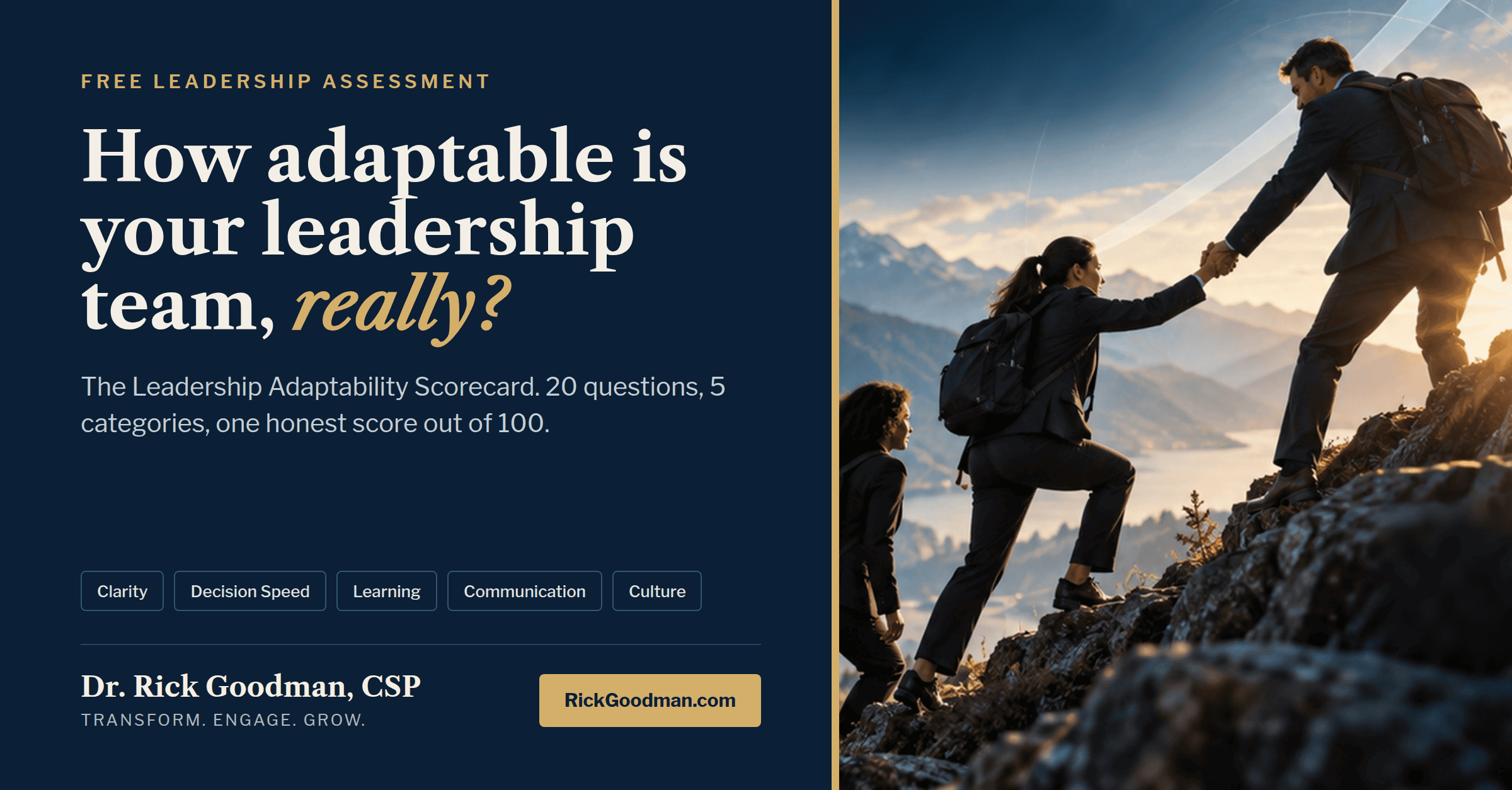
To make this practical, I built a free Leadership Adaptability Scorecard for leadership teams. The assessment measures your team across all five categories in about four minutes.
You answer 20 statements and immediately see your score out of 100, your leadership adaptability profile, and the category your team should address first.
Your result places your team into one of five profiles, ranging from Fragile Under Change to Adaptive Advantage. Most leaders find the result useful because it replaces assumptions with a measurable starting point.
Find out how your leadership team responds when conditions change and identify the capability that needs attention first.
Take the Free Leadership Adaptability ScorecardLeading Through Change: Turning the Score Into Momentum
Leading through change requires more than bigger announcements or increased urgency. A number alone changes nothing. Instead, leadership teams need a clear constraint, one visible behavior change, and leaders who model that behavior consistently.
For example, if decision speed receives the lowest score, clarify who owns which decisions. Then give managers the authority to act within those boundaries. If communication scores lowest, create a consistent process for explaining what changed, why it changed, and what employees should do next.
Likewise, if culture and resilience create the biggest constraint, leaders need to make constructive disagreement safer and more productive. The goal is not to eliminate tension. The goal is to turn tension into better decisions, faster learning, and stronger execution.
Leadership adaptability grows when teams repeat this process. Measure the behavior, identify the constraint, change one practice, and measure again. Ultimately, leading through change becomes more effective when leaders build these behaviors before the next disruption arrives.

About Dr. Rick Goodman, CSP
Dr. Rick Goodman is a Certified Speaking Professional, leadership expert, executive coach, and author. He has delivered more than 2,000 presentations and programs across all 50 states and 32 countries, helping organizations strengthen leadership, engagement, accountability, and performance.
His leadership programs help organizations develop solutions oriented cultures and build the adaptability required to lead through uncertainty and change.
Meet Dr. Rick GoodmanContinue Building Your Adaptive Leadership Framework
- Adaptive Leadership: Turning Disruption Into Competitive Advantage
- Adaptive Leadership Examples
- Leadership Adaptability Scorecard
- Solutions Oriented Leader Workshop
- Executive Coaching Services
Build a More Adaptive Leadership Team
If your score reveals gaps you want to close quickly, my keynotes, workshops, executive coaching programs, and leadership retreats help leadership teams strengthen the behaviors that drive adaptability.
We can focus the program on decision speed, communication, accountability, resilience, leading through uncertainty, or the specific constraint identified by your Leadership Adaptability Scorecard.
Check Dr. Rick Goodman's Availability