
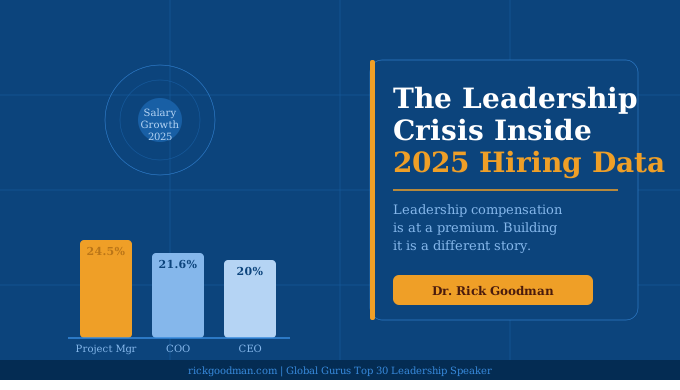
The most urgent leadership development challenge of 2025 is hiding in plain sight inside the global hiring data. Project managers are commanding 24.5% compensation growth. COOs are up 21.6%. CEOs up 20%. The market is paying a premium for leadership talent unlike anything we have seen in recent memory. Yet despite this, most organizations are still failing to invest in the leadership development strategies that would actually close the gap.
Paying more for a leadership title, however, is not the same as building a leader. That distinction is where organizations are quietly losing ground in 2025 and beyond.
What the 2025 Hiring Data Is Really Telling You About Leadership Development
When compensation for senior leadership roles outpaces every other function, it reflects one thing: scarcity. You cannot automate a great COO. You cannot offshore genuine leadership presence. The ability to inspire a team, align people around a mission, and drive results through uncertainty is deeply human and nearly impossible to replicate from the outside.
The same 2025 Deel Global Hiring Report shows that seven of the top ten roles being hired across borders globally are in sales, marketing, and customer-facing functions. The reason is straightforward. Local market knowledge and relationship leadership cannot be centralized. Organizations expanding globally are learning that lesson at significant cost.
Consequently, the same principle applies inside your organization. Leadership is local, personal, and irreplaceable. That reality makes intentional leadership development not a nice-to-have, but a core business strategy.
“The organizations winning right now are not just paying for leadership. They are building it, systematically and intentionally.”
— Dr. Rick Goodman
The Leadership Gap That Is Costing You More Than You Think
Here is the scenario playing out inside organizations across every industry right now. A company recruits a senior leader with an impressive resume and a top-of-market compensation package. Twelve months later, the team is still underperforming. Engagement scores have not moved. The culture has not shifted. Leadership is wondering what went wrong.
What went wrong is that they invested in a title without investing in the ecosystem around it. Furthermore, they neglected leadership development at every level below that hire. A culture that reinforces solutions-oriented thinking requires intentional architecture, not just strong hiring decisions. Systems that develop the next generation of leaders must be built before you need them, not after the gap becomes visible.
In 30 years of working with championship organizations across all 50 states and more than 30 countries, including the Miami Heat and the St. Louis Rams Super Bowl team, the pattern is entirely consistent. The best organizations are not just finding great leaders. They are building them deliberately through structured, ongoing leadership development investment.
Three Leadership Development Strategies That Actually Move the Needle
The framework I use with organizations is built around three core principles that drive measurable results.
Transform your thinking. The most effective leaders stop focusing on the problems in front of them and redirect their energy toward possibilities, solutions, and results. They are not firefighters. Instead, they are architects who build cultures where the default response to any challenge is forward momentum, not blame or defensiveness. This mindset shift is the foundation of every successful leadership development program I have delivered.
Optimize your assets. Your people are your most significant competitive advantage. Nevertheless, most organizations treat leadership development as a discretionary expense rather than a core business investment. The data increasingly makes the case for reversing that position. Organizations that invest consistently in developing their leaders see measurable returns in retention, engagement, and overall performance.
Accelerate your connectivity. The leaders who win in today’s environment are deeply connected to their teams, their clients, and the changing demands of their market. Disconnected leadership produces disengaged teams. That is not a theory. It is an observable, measurable pattern that shows up consistently across every organization I have worked with globally.
Your Leadership Development Strategy for 2025
Ask yourself one honest question. Is your investment in leadership development keeping pace with what the market is now paying for leadership talent?
If the answer is no, you are not falling behind slowly. The compounding effect of under-investment in leadership development accelerates over time. Therefore, the organizations that close that gap now will be in a fundamentally stronger competitive position twelve months from now than those that treat it as a future priority.
The market has already made its judgment. Leadership is the most valuable asset in your organization. Effective leadership development is how you build and protect that asset. The question is whether you are treating it that way.
For additional perspective on global workforce trends shaping leadership priorities, the Harvard Business Review leadership development resource library provides strong context alongside the Deel data.
Ready to Build a Solutions Oriented Leadership Culture?
Dr. Rick Goodman works with associations, corporations, and leadership teams worldwide to deliver leadership development programs that produce measurable results. Ranked Global Gurus Top 30 Leadership Speaker for six consecutive years.
Source: Deel 2025 State of Global Hiring Report. Data reflects compensation growth trends across global markets for active contracts on the Deel platform.