
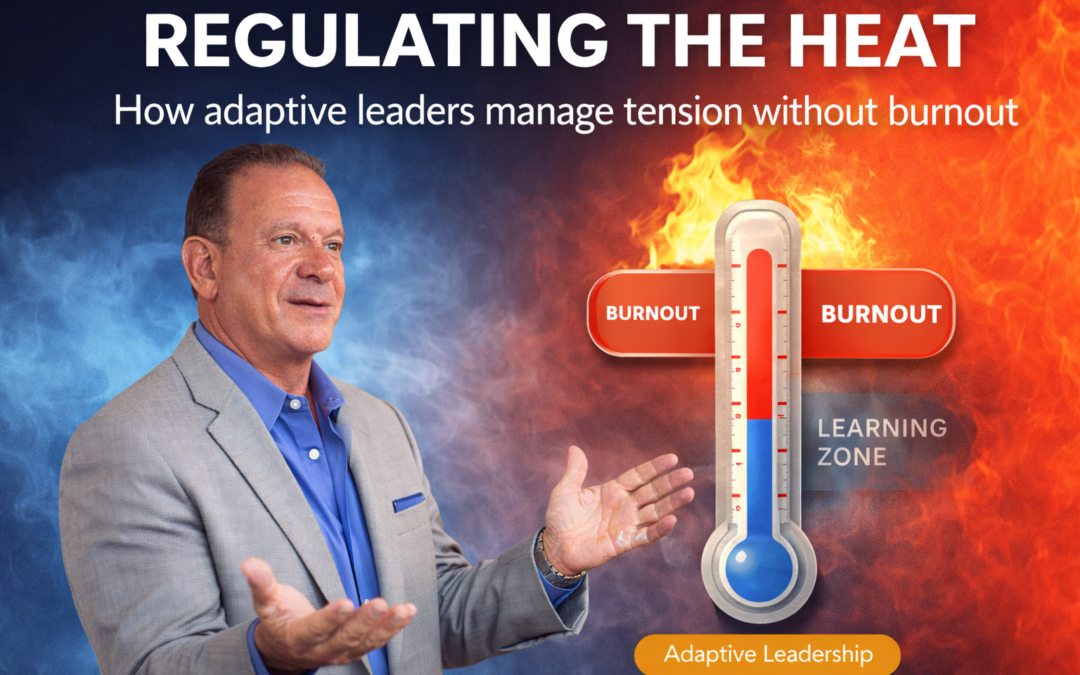
Regulating the Heat How Adaptive Leaders Manage Tension Without Burnout
Regulating the Heat Leadership shows how adaptive leaders manage tension without burnout. It is the discipline of managing tension so people stay in the learning zone. Change requires discomfort. Additionally, at the same time, unmanaged pressure creates defensiveness, shutdown, and burnout. The goal is progress that is sustainable. This post is part of the series. For the full model and the other tools, start with the Adaptive Leadership pillar page.Regulating the Heat Leadership starts with one truth
Tension is not the enemy. In fact, avoiding tension often slows change. Instead, leaders need productive discomfort, enough to spark focus and honest conversations. However, when heat goes too high, learning stops. As pressure rises, people protect themselves. Some push back, while others go silent. In many cases, teams pretend to agree and then do nothing.Thermostat leadership: lead without burnout
In adaptive leadership, the leader is not the firefighter who puts out every flame. The leader is the thermostat that keeps the team in the learning zone.Regulating the Heat Leadership move three: protect respectful dissent
Regulating the Heat Leadership means choosing the right move at the right time.-
-
- Raise the heat by naming the real question.
- Lower the heat by slowing the tempo.
- Hold steady by protecting respectful dissent.
-
Managing tension: how to raise the heat
Raise heat when the room is polite, vague, or stuck in surface level talk. In other words, the meeting looks productive but nothing changes. The aim is focus, not conflict.Regulating the Heat Leadership move one Name the real question
Say what everyone is circling around. For example, what decision are we avoiding. What behavior must change. What are we not willing to give up.Make tradeoffs visible
Adaptive work always contains competing values. Speed versus safety. Autonomy versus consistency. Growth versus stability. When the tradeoff is clear, the conversation becomes more honest and more useful.Ask for commitments, not opinions
Opinions are easy. Commitments reveal reality. So ask what will you do by next week. Next, ask what you will stop doing. Finally, ask what you will measure.Give the work to the people closest to it
When leaders keep the work at the top, teams wait. When leaders bring the work to the people closest to it, teams learn. As a result, ownership rises and energy improves.Lowering the temperature: how to reduce overwhelm
Lower heat when you see overwhelm. For example, watch for silence, sarcasm, side conversations, or fast agreement that feels fake. Those signals usually mean the heat is too high for learning.Regulating the Heat Leadership move two: Slow the tempo
Reduce the pace. Summarize what you heard. Confirm what is true. Then choose one next step.Shrink the problem
Turn a huge change into a small test. One team. One process. One month. Clear measures. A learning review. This keeps progress moving while lowering stress.Increase structure
Structure lowers anxiety. Set an agenda. Clarify roles. Define how decisions will be made. Clear rules help people reengage.Normalize the discomfort
Acknowledge that this is hard. Normalize the uncertainty. Remind the team this is learning work. People do not need you to pretend it is easy. They need you to lead it.Staying in the learning zone: how to hold steady
Holding steady is often the hardest skill. Leaders either push too hard or rescue too fast. Regulating the Heat Leadership requires steady leadership when the group is doing honest work.Protect respectful dissent
Invite disagreement. Keep it respectful. Reward truth telling. Adaptive work cannot be done in a culture of polite avoidance.Keep attention on purpose
When the conversation drifts, pull it back to why it matters. Who is impacted. What success looks like. What the cost of delay is.Reinforce progress
Call out small wins. Celebrate new behaviors. Reinforcement keeps people in the work without burning them out.A simple real world example
Picture a leadership team rolling out a major change. Meetings are tense, and progress feels uneven. Some people get quiet, while others push back. Meanwhile, a few are working weekends and still feel behind.
If you raise the heat more, the room breaks. If you lower the heat too much, nothing changes. Regulating the Heat Leadership means doing both, on purpose. First, lower heat by shrinking the work into a small test, clarifying decision rights, and setting a clear timeline for the next review. Then raise heat by asking for one visible behavior change from each leader and one measurable commitment that the team will actually notice. That combination creates progress without burnout.