
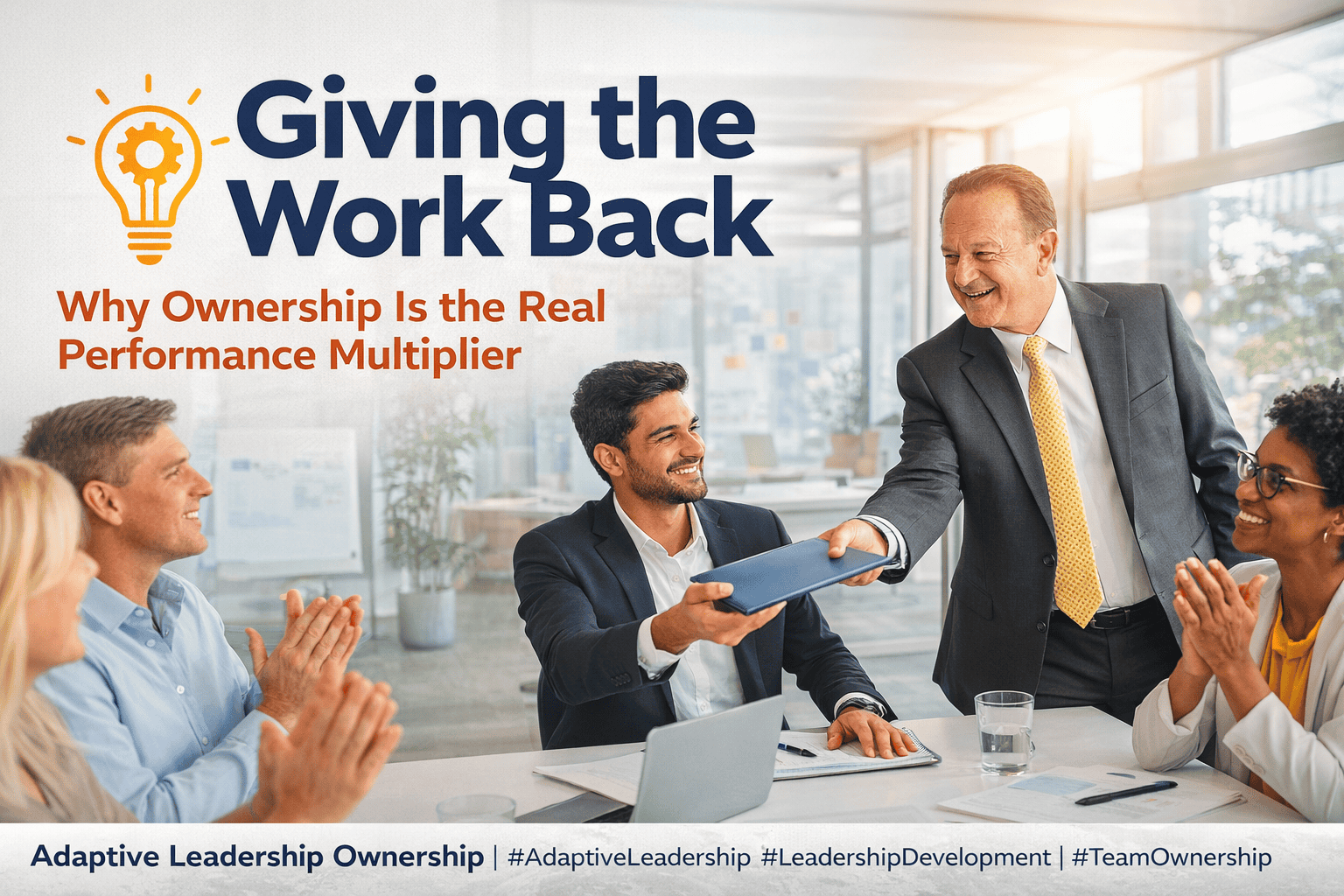
Adaptive leadership ownership is the difference between a team that executes and a team that waits. When leaders carry the problem, teams stay dependent. When leaders give the work back, teams build capability, accountability, and momentum. The performance gap between those two cultures is not talent. It is who owns the work.
This article is part of the Adaptive Leadership series. For the full model and the other tools, start with the complete guide to adaptive leadership.
Why Leaders Keep the Work, and Why It Backfires
Most leaders keep the work for understandable reasons. You are responsible, you move fast, and you can fix it. Nobody wants their team to fail. However, when the leader becomes the solution, the team becomes a spectator.
Here is the hidden cost. The more you rescue, the more your team waits. Over time, therefore, you train capable people to bring you problems instead of decisions, experiments, and learning. Consequently, the team gets weaker, the leader gets busier, and performance becomes fragile, entirely dependent on one person's bandwidth.
Adaptive Leadership Ownership Is Not Abdication
Giving the work back is not dumping tasks or disappearing. It is a deliberate leadership choice to move ownership to the people closest to the work while you keep responsibility for direction, guardrails, and coaching.
Specifically, you stay accountable for outcomes while the team becomes accountable for execution and learning. That distinction is everything. Without direction, ownership creates chaos. Without ownership, direction creates dependency. Together, however, the combination builds a high-performing team that does not need constant supervision to deliver results.
Three Signals You Are Carrying the Work
Signal One: Every Decision Escalates to You
If your team cannot decide without you, the issue is not intelligence. It is unclear decision rights or a culture that punishes initiative. Adaptive leadership ownership requires clarity about who decides, who advises, and who executes. When that clarity is absent, people default to escalation every time.
Signal Two: Meetings Sound Productive, But Nothing Changes
When you do most of the talking and the follow-up depends on you, the team learns to agree in the room and stall in real life. Ownership shows up in commitments, deadlines, and visible behavior change between meetings, not in the quality of the conversation during them.
Signal Three: You Are the Bottleneck
If progress slows when you travel or get busy, the system is dependent on you. As a result, that becomes both a leadership risk and an execution risk simultaneously. High-performing teams, by contrast, run on shared responsibility rather than heroic individual effort from the person at the top.
Bring Dr. Rick Goodman to your next leadership event to give your leaders a shared framework for transferring ownership without losing accountability.
How to Transfer Ownership Without Losing Accountability
Step One: Name What Must Be Owned
Be specific. Do not assign a vague outcome like "improve communication." Assign a concrete problem to solve and a measurable definition of done. Use these questions to open the conversation:
- What problem are we solving, and why does it matter now?
- What does success look like in 30 days?
- What constraints must we respect, including budget, compliance, brand, and safety?
Step Two: Clarify Decision Rights
This is where most empowerment collapses. People hesitate when they do not know what they are allowed to decide. Use a simple rule set that removes the ambiguity:
- You decide when the risk is high or the decision is irreversible
- We decide when alignment is essential across functions
- You decide with guardrails when speed and learning matter most
When you clarify decision rights and coach the thinking rather than supplying the answer, ownership becomes a system rather than a personality trait. Furthermore, research on empowerment consistently shows that the most common reason empowerment fails is not lack of motivation but lack of clarity about boundaries and authority.
Step Three: Shift From Answers to Coaching
When your team asks what to do, the instinct is to answer. Instead, train ownership by coaching the thinking. Use these prompts to shift the dynamic:
- What are two options you are considering?
- Which data do we have, and what assumptions are we making?
- How might we run a small test this week to find out?
- Where do you need my support, and where can you move forward without me?
Step Four: Close Every Meeting With Ownership Commitments
Status updates feel safe. Commitments create results. Close meetings with clear owners, dates, and measures using this structure:
- Owner: who is accountable for the next step
- Deadline: when it will be done
- Measure: how you will know it worked
- Learning: what the team will do if it does not work
Adaptive Leadership Ownership in Practice
Imagine a leader who constantly jumps into customer escalations. The team is capable, but they wait because the leader always takes over. The leader is busy, the team is underdeveloped, and performance stays fragile.
Giving the work back looks like this. The leader defines the outcome, sets guardrails, and assigns a team lead to run a weekly escalation review. From there, the team owns the decisions within defined limits, tests solutions, and reports learning. As a result, the leader stops being the bottleneck and the team gains confidence and capability simultaneously.
"Adaptive leadership ownership grows when the people closest to the work own the next decision and the next action. That is how teams stop waiting and start leading."
What to Measure to Know It Is Working
Ownership is visible. Track these indicators over 30 days:
- Fewer escalations for decisions the team should own
- More decisions made at the level closest to the work
- Clearer commitments with fewer missed deadlines
- More experimentation and faster learning cycles
For broader workplace research on engagement and team performance, Gallup's workplace research provides strong benchmarking data on what drives ownership and accountability at the team level. According to Thought Leaders Journal, leaders who systematically transfer ownership through clear decision rights see measurably faster team development than those who rely on motivation and culture messaging alone.
Bottom Line on Adaptive Leadership Ownership
Adaptive leadership ownership is built when leaders give the work back with clear guardrails, measurable commitments, and coaching that drives learning and execution. The goal is not to be less involved. It is to be involved in the right things at the right level, while your team owns everything else.

About Dr. Rick Goodman, CSP
Dr. Rick Goodman is a Certified Speaking Professional, six-time Global Gurus Top 30 Leadership Expert (2021 to 2026), and author of five books including the Amazon number one bestseller The Solutions Oriented Leader. He has delivered more than 2,000 programs across all 50 states and 32 countries, helping leaders build teams that own the work instead of waiting on the leader for every decision.
His keynote programs, workshops, and executive coaching engagements are customized and immediately actionable.
Continue Building Your Adaptive Leadership Framework
- Adaptive Leadership: Turning Disruption Into Advantage
- Adaptive Leadership vs Traditional Leadership
- Adaptive Leadership in Action: Real World Examples
- Building an Adaptive Leadership Culture
- Regulating the Heat: How Adaptive Leaders Manage Tension Without Burnout
- Executive Coaching Services
Build a Team That Owns the Work and Delivers the Results
Dr. Rick Goodman is a Certified Speaking Professional ranked among the Top 30 Global Leadership Gurus. His keynote programs, leadership retreats, and executive coaching give leaders the specific tools to transfer ownership, build accountability, and develop teams that execute without constant direction.