
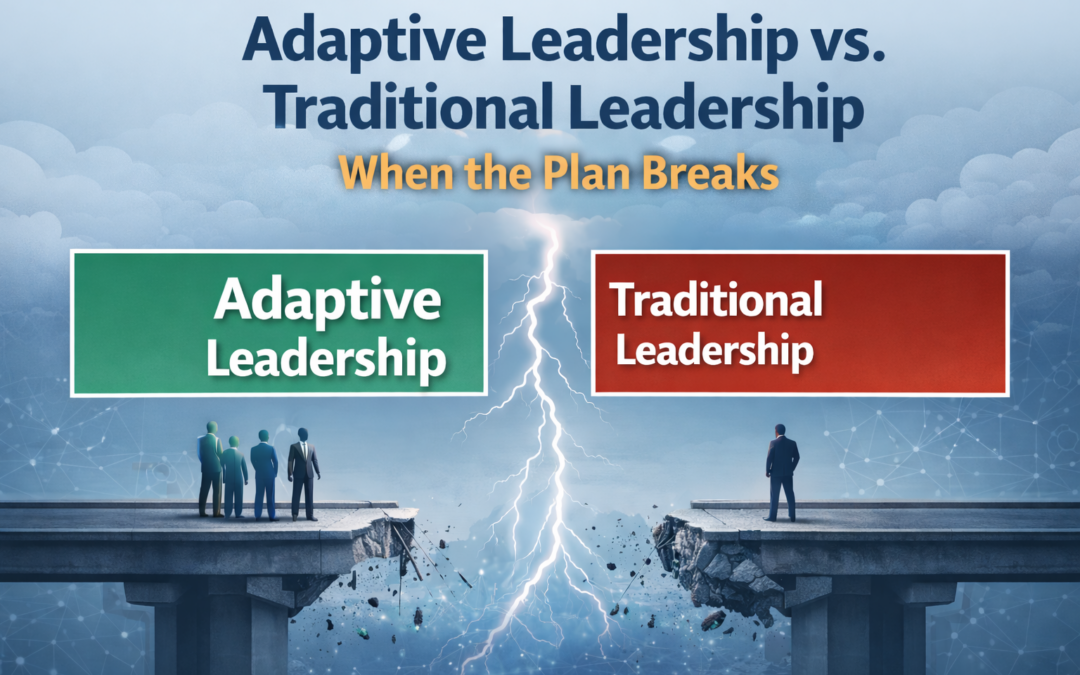
Adaptive Leadership vs. Traditional Leadership: Why the Old Playbook Breaks Under Pressure
Adaptive leadership vs traditional leadership reveals why many well-intentioned leaders struggle when uncertainty, complexity, and rapid change become the norm. What once worked in stable environments now breaks under pressure. Traditional leadership works in stable conditions. Adaptive leadership wins when uncertainty becomes the operating environment.
This article is part of the Adaptive Leadership series. If you haven’t read the pillar yet, start here: Beyond the Unthinkable: How Adaptive Leadership Turns Disruption into Competitive Advantage
.
Adaptive Leadership vs Traditional Leadership in Stable Conditions
For decades, leadership development was built on a stable assumption:
if leaders plan well, give clear direction, and maintain control, organizations will perform.
Traditional leadership works best when:
- The problem is clear
- The solution is known
- Authority can be exercised to produce results
In these environments, leaders succeed by setting direction, enforcing standards, and driving compliance.
This model is efficient when conditions are predictable.
The problem isn’t that traditional leadership is wrong.
The problem is that it is situational—and many leaders still rely on it when the situation has changed.
Where Adaptive Leadership vs Traditional Leadership Break Down
Traditional leadership struggles when:
- Problems are ill-defined
- Solutions are not obvious
- Conditions change faster than plans
- People—not just processes—must adapt
In these moments, leaders often tighten control, increase meetings, and delay decisions while waiting for certainty.
That response feels responsible. It usually slows the organization down.
This is the central difference in adaptive leadership vs traditional leadership, one prioritizes control, the other builds capacity to respond when certainty disappears.
Pressure test: If every decision funnels upward, leadership becomes the bottleneck.
Adaptive Leadership vs Traditional Leadership in Uncertain Environments
Adaptive leadership is not about reacting faster or working harder.
It’s about leading effectively when answers are incomplete and authority alone won’t solve the problem.
Adaptive leadership is required when:
- The problem is evolving
- The solution must be learned in real time
- Expertise is distributed, not centralized
- Execution depends on ownership, not compliance
In these environments, leadership shifts from control to mobilizing intelligence across the system.
Key Differences That Matter in Practice
1.Control vs Capacity in Adaptive vs Traditional Leadership
Traditional leadership emphasizes control: leaders decide, teams execute.
Adaptive leadership emphasizes capacity: leaders create clarity and guardrails, then empower teams to think and act.
2. Authority vs. Engagement
Traditional leadership relies on positional authority.
Adaptive leadership relies on engagement, candor, and shared responsibility.
3. Planning vs. Learning
Traditional leadership prioritizes planning.
Adaptive leadership prioritizes experimentation, feedback, and learning.
Plans become hypotheses—not guarantees.
4. Certainty vs. Clarity
Traditional leadership waits for certainty.
Adaptive leadership creates clarity and momentum when certainty isn’t available.
Why Adaptive Leadership Outperforms Under Pressure
Organizations that practice adaptive leadership demonstrate:
- Faster decision-making
- Higher ownership
- Stronger cross-functional collaboration
- Greater resilience during disruption
Teams empowered to think and act adapt faster than those waiting for instructions.
Adaptive leadership turns disruption into a learning advantage.
How This Connects to Solutions-Oriented Leadership
Adaptive leadership depends on solutions-oriented leadership.
Leaders who replace blame with ownership and focus on forward progress are far more effective in uncertain environments.
If you want a clear snapshot of how you lead under pressure, start here: Solutions-Oriented Leader Assessment
.
The Bottom Line
Traditional leadership is efficient in stable environments. Adaptive leadership is essential in uncertain ones.
The leaders who outperform today aren’t abandoning structure. They’re evolving how leadership shows up when the plan breaks.
Next steps:
Explore Leadership Workshops or
Book Dr. Rick Goodman to Work With Your Leaders.